Friday, June 29, 2007
My first 1000km
The 1000km to Montana reminded me of how much fun and challenge I had on my first 1000km brevet eight years ago. I wrote a story on it at the time, which can be found here.

Wednesday, June 27, 2007
Montana 1000km
Portland, OR to Whitefish, MT. From the time that Susan France, Portland RBA, described her plans to create a one-way 1000km brevet to Whitefish, I knew that I needed to ride it. (In the lexicon of my randonneuring obsession, "need" means that resistance to the urge would be futile.) Scheduled for the end of June, the brevet would take advantage of long daylight hours to provide ample opportunity to sample incredible scenery. Along with Paris-Brest-Paris, this would be one of the not-miss events for me in 2007.
A few weeks ago, I helped Wayne out with a control on the SIR 600km brevet. (See A Weekend Off). Greg Cox came into the control and tossed out a tantalizing suggestion: I should join him for the scouting pre-ride of the Montana 1000km a week before the event. Of course, this would be insane. Riding unsupported would only add to the challenge. Doing 1000km with only 12 days off from my planned pre-ride of the SIR 1000km brevet might be pushing it. "Don't you think you might be over-training?" asked my tolerant but concerned spouse. I tried to explain that it was not a training ride, it was a goal in itself. My teenage daughter would say "whatev", but Chris just used a look to convey the same resigned disbelief. My family has no faith in my sanity.
"Insane" translated to "need" pretty quickly, and by the next afternoon, when I saw Greg at the 600km finish, I was in.
Riding with Greg would be a blast. We met in my first season of randonneuring (1998) and we've rode many events together since. In 1999, Greg, Bill Dussler, Wayne Methner, Peter McKay, and I rode most of PBP together. At controls, we'd meet a big van with spouses Mary Cox, Bonnie Dussler, Anita McKay, and Chris Thomas, along with children Alaina Dussler, Philip Thomas, and Elena Thomas. Although Greg is a much stronger cyclist than I am, he's a great riding companion and really helped me keep going toward the end of that first 1200km. We did the Rocky Mountain 1200km together in 2002 and PBP again in 2003. We've been on numerous fleche teams together as well. Greg and I also share a similar sense of humor (tending to the sophomoric as the miles pile up), and if you're going to pedal over 600 miles, it helps to laugh.
I would need to sort out the logistics of transportation to Portland, return of rider and bike from Whitefish, and a family vacation, but those were just details. Although I'm sure easier ways exist, they didn't occur to me during the busy couple of weeks (1000km pre-ride and managing the 600/1000/400 weekend), so with inspiration from Rube Goldberg, I came up with the following. Drive from Redmond to Troutdale (start location) Friday night, drop off bike and stuff, drive to Portland airport and leave car in long term lot, take cab back to hotel, ride bike to Montana, take bike to bike shop in Whitefish to be shipped back to Redmond, fly from Whitefish to Alabama to join the family visit in progress (where I am now), fly back to Portland, pick up car, and drive home. In addition, I would rely on the US Postal Service to send stuff ahead to our overnight stop motels and to the motel in Whitefish.
We drove to Portland Thursday night, had a nice dinner at the Edgefield Lodge (start location), and prepped our bikes for an early departure. Greg's plans included a Sunday night train back from Whitefish. We pushed the start time to 4AM to give a little extra margin for him to make the train (64 hour finish instead of 63). Even 64 would be too fast for me - my previous fastest 1000km was 65:28 - but we'd figure that out later.
 After about an hour of pre-dawn riding on Saturday, we descended toward the Columbia River Gorge (past the information control at the Crown Point Vista House). The vista did not disappoint. The simply spectacular view of the gorge with the sun just starting to rise upriver marked only the beginning of the great scenery that would characterize this ride.

We passed great waterfalls on the way to our crossing of the Columbia River on the Bridge of the Gods. (We also walked our bikes down a long flight of steps, which might be a brevet first for me). The tollkeeper on the bridge waved us through without charge. Despite the warning on the cue sheet, I looked down through the steel grated bridge to the river below. Briefly.
Once on the Washington side, the route follows SR-14 for 200km along the Columbia. A beautiful stretch of road, but unlike the river, it's not flat. Here we were introduced to the tailwind that would assist us for most of the rest of the brevet. (Note to this weekend's riders: The road goes through quite a few tunnels between the bridge crossing and the US-97 intersection. I recommend leaving a taillight on for this stretch and also stopping to activate the "bikes in tunnel" warning lights.)
 We fueled up at the control in Lyle and continued up the river. I insisted that we take a detour (just past the US-97 intersection) to see Stonehenge. We rode down to the bluff where early 20th century railroad executive Sam Hill built a full-scale replica of Stonehenge as a monument to WWI soldiers. It's weird and worth the short detour. We also got water and sodas at the gift shop there, which probably helped us get through the next section.

At Roosevelt, the control was at a nice little market. The lady inside signed our cards in return for us making entries in her guest book. She had realized early in her tenure there that cyclists seemed to come through often, and she started a book for their notes. (Note to this weekend's riders: Not much is available from Roosevelt to Kennewick, a distance of 120km. The cafe at Patterson 54km from Roosevelt was closed on Saturday. A short ways up from the cafe was a church with a nice hose bib on the front. We got water there after Greg observed that the spigot behind the cafe was nasty. The route sheet indicates a part with water on the right near the turn to Plymouth Road, 75km from Roosevelt. This appears to be some ways off the road. There is an RV park on the left after the turn which may have water).
We left the river on Plymouth Road. A long climb was rewarded with a nice descent toward the Tri-cities. The Burger King served as our control stop at about 7:30PM. There Greg called ahead to our overnight motel in Connell and was treated to some less than welcome news. Although the motel had received slips from the post office informing them of arriving packages, those packages had not been retrieved. As a result, nothing would come of our efforts to have a change of clothes, more food, toiletries, etc. at the first overnight. We quickly concluded that this was not the worst thing that had ever happened to us. Assuming (correctly, as it turned out) that not much would be available after we left the Tri-Cities, we stopped at the grocery store for extra food and at a drug store for some overnight essentials. Night fell on the way into Connell, where we arrived at the M&M Motel just before midnight.
Saturday found us rolling through the Palouse area of Eastern Washington. In addition to the rolling wheat fields, we started the day riding through one of the canyons (Washtucna Coulee) formed by the sudden drainage of glacial Lake Missoula when ice dams burst during the last ice age. (Similar features exist further west in Washington and are a feature of day 3 of the Cascade 1200 route). A handout at one of the stores along the way provided this geological backround, as well as the welcome news that the term "channeled scablands" refers to the local geology, not to the likely state of our posteriors after 1000km.
We enjoyed breakfast about 50km into the day at the store in Washtucna at the intersection with SR-26. Good espresso and a nice porch. A detour about 30km later took us into LaCrosse and up a gratuitous hill, but rewarded us with a fine view before we descended back to rejoin SR-26. More snacks and refreshments at the Dusty Market were welcome. (Rider note: From the overnight to the full control at Colfax is over 135km. No services exist at the information controls. Stopping at Washtucna after 50km and Dusty after another 55km worked well for us).
We came down the steep hill into Colfax and made our control stop at the local Arby's at about 1PM. From the control was a pretty good climb out of town into more farmlands. At one point, the scenery looked familiar even though I'd never been to this area before. It came to me when I looked left and saw the Microsoft Windows XP default screen background. We skirted Steptoe Butte and passed through the farming towns of Oakesdale and Tekoa. In the nearly deserted downtown of Tekoa (at least on a Saturday afternoon) is a nice little pocket park with a water pump.
A couple miles of gravel and a good steep hill led us to US-95 into Plummer for another control. It was about 5:30, so we made a dinner stop at the grocery store. From Plummer, the 1000km route crosses the panhandle of Idaho on the Coeur d'Alene bicycle trail. In service of Greg's plan for a Sunday night train, our plan was to cycle 106km along the trail to Wallace, ID before stopping. (Most riders on the regular brevet will stop after 88km in Kellogg, ID).
 The Coeur d'Alene trail provides a beautiful, no traffic route across Idaho. The first part of the trail descends to Lake Coeur d'Alene, crosses the lake on a bridge, runs along the east side of the lake, and then heads up the Coeur d'Alene river past a number of lakes. After about 80km, it starts to parallel I-90 and is a bit less appealing, but the first 80km were spectacular. With railway grades, this should be easy riding. With 600km done, however, I was having trouble keeping up as Greg effortlessly spun up to 30kph & more. After Kellogg, Greg rode on ahead (as he had Friday night into Connell), allowing more efficient use of the motel room & shower.
Finding the Ryan Hotel in Wallace took a while, but the old hotel offered a charming room and the very welcome sight of a USPS Priority Mail box with my name on it. After 715km, I would have fresh shorts (among other delights). Greg indicated his plan to leave by around 4AM to make his train. We agreed to ride separately - with two big passes at the start on Sunday, Greg would need to wait around for me and might miss his train. I was happy to ride at my own slow pace for the last 300km.
After the beautiful weather of the prior two days, the sound of rainfall (sounding more like a garden hose on the window, really) in the middle of the night was less than soothing. By our 4AM departure, it had settled to a steady drizzle. The climb up Dobson Pass starts right out of Wallace and ascends 1400 feet in 6 miles. Despite the rain, the climb was beautiful. The pre-dawn light, the clouds and fog nestled in the trees, and the sound of water in the creek alongside created a prehistoric forest atmosphere. Not moving quickly, I made steady progress nonetheless and enjoyed the quiet solitude.
The descent from the 4090 foot summit of Dobson Pass was a rude shock. Last year at this time, temperatures well over 100 degrees forced me out of the Cascade 1200. A year and a day later, I had the opposite problem. Despite my usual wool togs, I was chilled to the core. I'm not sure how much of the next 30km was downhill, but I was not generating much heat as I lost 170o feet of elevation. Being 750km worth of tired probable didn't help either. I pulled off the rainy road into the shut-up-tight town of Murray. The Sprag Pole Inn might have been a great place for breakfast, but they aren't open on Sunday. I opened a never-before used space blanket and wrapped myself up on the porch. I may have napped briefly as I warmed up. When a break in the rain came, I headed off to Thompson Pass.
 A long slow climb (9 miles, 2500 feet, what seemed like hours) led to the Idaho-Montana border at the summit of Thompson Pass. Fresh snow in the hillsides probably not more than 500 feet above the pass elevation proffered a further explanation for my morning chill. By the time I reached the town of Thompson Falls in Montana, hunger and weariness led me to refuge in Minnie's Montana Cafe. An enormous plate of food (some sort of breakfast scramble), two cups of hot chocolate, and a good nap in the booth later, I was finally ready for more. Safe traveling wishes from the waitress and the couple at the next table helped too. It was nearly noon (now in Mountain time) and with stops I had spent almost 7 hours covering less than 100km from the overnight. I hoped to make quicker progress over the remaining 200km.

Much of SR-200 from Thompson Falls to Plains has minimal shoulders. Although the traffic was not heavy, the rumble of approaching 18-wheelers detracted from the beauty of the Clark Fork River to the right. Along the way, I found a nice rocky spot to sit and look at the river. I thought of a Dylan lyric: "I'll just sit here so contentedly and watch the river flow." On most of the 1000km brevets that I've done (this was my eighth), I start to lose focus on making good time on the third day. I'm not sure why, but maybe because the pace requirements for brevets slow after 600km, which helps me relax about finishing in time, or maybe because I'm tired and find it easier to justify rest stops. For whatever reason, between Wallace, ID and the first real control of the day in Plains, MT, I had my rando burrito act in Murray, my long breakfast in Thompson Falls, this stop to watch the river flow, and then just before the Plains control, a nap on a picnic table outside the towns old historic schoolhouse.
Restocked at the grocery store in Plains, I left at around 3PM for the last 150+km to the finish. Right out of Plains on SR-28 is a five mile climb that I could have done without. It would be a total of 80km to reach Flathead Lake. Happily the store was still open at Lonepine when I came through. The friendly proprietor made a hamburger for me and asked about my ride. He mentioned that another rider a couple hours earlier had been on the same ride and that he thought the other guy would make his train (but I wouldn't). I was happy to hear good news of Greg's progress.
Through Lonepine, SR-28 heads almost due north for a ways. Thinking that I was eastbound, however, I spent a lot of time worrying about how the strong crosswind from my left would be a headwind when I reached the lake and turned north. Relief came when I turned again and a strong tailwind pushed me toward the lake.

Flathead Lake is beautiful, but the next 40km were tough for me. Following a pattern that will be familiar to many NW riders, the road along the flat body of water was anything but flat. On fresh legs, I might have enjoyed these, but instead I gave my granny gear a workout and whined to myself a lot. My last refreshment stop came in Lakeside (50km from the finish). (Note to this weekend's riders: It's a long 110km from Plains to Lakeside. I'd recommend fueling up where the opportunity presents itself - at Hot Springs or Lonepine on SR-28 or at Rollins or Lakeside along US-93).
After Lakeside, only a couple more hills before the route took us on a bicycle trail paralleling US-93. The last 40km used the bike trail, a flat section of US-93 after the trail ends, some side streets in Kalispell, and the Whitefish Stage Road from Kalispell to Whitefish. This section was quiet and uneventful (and, for me, slow). I arrived at the finish motel exhausted and exhilarated at 11:40pm (total brevet time of 66:40).
Reflecting over the ride, I realize that this was a special cycling experience. Certainly one of my favorite long events for scenery. The views delighted over and over and offered substantial variety. Riding with Greg for two days was, as expected, a blast. The challenge was substantial and rewarding. Honestly, I had underestimated the brevet, thinking that it would be a fairly flat 1000km with a constant tailwind. The tailwind did not disappoint, but the route challenged me nonetheless. With about 26,000ft of climbing (6000ft in the first 200km, 4000ft in second 200km, 6000ft in the next 300km, and 10,000ft in the last 300km), the route was not flat. Over it's length, the route gains 3000ft of net elevation and it saves much of its climbing for the last day. Riding unsupported (and 1 for 2 on packages at the overnight stops) and riding without a lot of rest added to the challenge. For all these reasons, and probably more that remain subconscious still, I loved this ride. Thanks to Susan and friends for putting the route together. Bonne route to the riders this weekend. I hope you enjoy it too.
A footnote - I rode without mechanical incident; not so much as a flat tire. A very good thing too; I discovered on the second night in Wallace that despite the tons of stuff in my bags, I had left all my tools at home.
A few weeks ago, I helped Wayne out with a control on the SIR 600km brevet. (See A Weekend Off). Greg Cox came into the control and tossed out a tantalizing suggestion: I should join him for the scouting pre-ride of the Montana 1000km a week before the event. Of course, this would be insane. Riding unsupported would only add to the challenge. Doing 1000km with only 12 days off from my planned pre-ride of the SIR 1000km brevet might be pushing it. "Don't you think you might be over-training?" asked my tolerant but concerned spouse. I tried to explain that it was not a training ride, it was a goal in itself. My teenage daughter would say "whatev", but Chris just used a look to convey the same resigned disbelief. My family has no faith in my sanity.
"Insane" translated to "need" pretty quickly, and by the next afternoon, when I saw Greg at the 600km finish, I was in.
Riding with Greg would be a blast. We met in my first season of randonneuring (1998) and we've rode many events together since. In 1999, Greg, Bill Dussler, Wayne Methner, Peter McKay, and I rode most of PBP together. At controls, we'd meet a big van with spouses Mary Cox, Bonnie Dussler, Anita McKay, and Chris Thomas, along with children Alaina Dussler, Philip Thomas, and Elena Thomas. Although Greg is a much stronger cyclist than I am, he's a great riding companion and really helped me keep going toward the end of that first 1200km. We did the Rocky Mountain 1200km together in 2002 and PBP again in 2003. We've been on numerous fleche teams together as well. Greg and I also share a similar sense of humor (tending to the sophomoric as the miles pile up), and if you're going to pedal over 600 miles, it helps to laugh.
I would need to sort out the logistics of transportation to Portland, return of rider and bike from Whitefish, and a family vacation, but those were just details. Although I'm sure easier ways exist, they didn't occur to me during the busy couple of weeks (1000km pre-ride and managing the 600/1000/400 weekend), so with inspiration from Rube Goldberg, I came up with the following. Drive from Redmond to Troutdale (start location) Friday night, drop off bike and stuff, drive to Portland airport and leave car in long term lot, take cab back to hotel, ride bike to Montana, take bike to bike shop in Whitefish to be shipped back to Redmond, fly from Whitefish to Alabama to join the family visit in progress (where I am now), fly back to Portland, pick up car, and drive home. In addition, I would rely on the US Postal Service to send stuff ahead to our overnight stop motels and to the motel in Whitefish.
We drove to Portland Thursday night, had a nice dinner at the Edgefield Lodge (start location), and prepped our bikes for an early departure. Greg's plans included a Sunday night train back from Whitefish. We pushed the start time to 4AM to give a little extra margin for him to make the train (64 hour finish instead of 63). Even 64 would be too fast for me - my previous fastest 1000km was 65:28 - but we'd figure that out later.
 After about an hour of pre-dawn riding on Saturday, we descended toward the Columbia River Gorge (past the information control at the Crown Point Vista House). The vista did not disappoint. The simply spectacular view of the gorge with the sun just starting to rise upriver marked only the beginning of the great scenery that would characterize this ride.
We passed great waterfalls on the way to our crossing of the Columbia River on the Bridge of the Gods. (We also walked our bikes down a long flight of steps, which might be a brevet first for me). The tollkeeper on the bridge waved us through without charge. Despite the warning on the cue sheet, I looked down through the steel grated bridge to the river below. Briefly.
Once on the Washington side, the route follows SR-14 for 200km along the Columbia. A beautiful stretch of road, but unlike the river, it's not flat. Here we were introduced to the tailwind that would assist us for most of the rest of the brevet. (Note to this weekend's riders: The road goes through quite a few tunnels between the bridge crossing and the US-97 intersection. I recommend leaving a taillight on for this stretch and also stopping to activate the "bikes in tunnel" warning lights.)
 We fueled up at the control in Lyle and continued up the river. I insisted that we take a detour (just past the US-97 intersection) to see Stonehenge. We rode down to the bluff where early 20th century railroad executive Sam Hill built a full-scale replica of Stonehenge as a monument to WWI soldiers. It's weird and worth the short detour. We also got water and sodas at the gift shop there, which probably helped us get through the next section.
At Roosevelt, the control was at a nice little market. The lady inside signed our cards in return for us making entries in her guest book. She had realized early in her tenure there that cyclists seemed to come through often, and she started a book for their notes. (Note to this weekend's riders: Not much is available from Roosevelt to Kennewick, a distance of 120km. The cafe at Patterson 54km from Roosevelt was closed on Saturday. A short ways up from the cafe was a church with a nice hose bib on the front. We got water there after Greg observed that the spigot behind the cafe was nasty. The route sheet indicates a part with water on the right near the turn to Plymouth Road, 75km from Roosevelt. This appears to be some ways off the road. There is an RV park on the left after the turn which may have water).
We left the river on Plymouth Road. A long climb was rewarded with a nice descent toward the Tri-cities. The Burger King served as our control stop at about 7:30PM. There Greg called ahead to our overnight motel in Connell and was treated to some less than welcome news. Although the motel had received slips from the post office informing them of arriving packages, those packages had not been retrieved. As a result, nothing would come of our efforts to have a change of clothes, more food, toiletries, etc. at the first overnight. We quickly concluded that this was not the worst thing that had ever happened to us. Assuming (correctly, as it turned out) that not much would be available after we left the Tri-Cities, we stopped at the grocery store for extra food and at a drug store for some overnight essentials. Night fell on the way into Connell, where we arrived at the M&M Motel just before midnight.
Saturday found us rolling through the Palouse area of Eastern Washington. In addition to the rolling wheat fields, we started the day riding through one of the canyons (Washtucna Coulee) formed by the sudden drainage of glacial Lake Missoula when ice dams burst during the last ice age. (Similar features exist further west in Washington and are a feature of day 3 of the Cascade 1200 route). A handout at one of the stores along the way provided this geological backround, as well as the welcome news that the term "channeled scablands" refers to the local geology, not to the likely state of our posteriors after 1000km.
We enjoyed breakfast about 50km into the day at the store in Washtucna at the intersection with SR-26. Good espresso and a nice porch. A detour about 30km later took us into LaCrosse and up a gratuitous hill, but rewarded us with a fine view before we descended back to rejoin SR-26. More snacks and refreshments at the Dusty Market were welcome. (Rider note: From the overnight to the full control at Colfax is over 135km. No services exist at the information controls. Stopping at Washtucna after 50km and Dusty after another 55km worked well for us).
We came down the steep hill into Colfax and made our control stop at the local Arby's at about 1PM. From the control was a pretty good climb out of town into more farmlands. At one point, the scenery looked familiar even though I'd never been to this area before. It came to me when I looked left and saw the Microsoft Windows XP default screen background. We skirted Steptoe Butte and passed through the farming towns of Oakesdale and Tekoa. In the nearly deserted downtown of Tekoa (at least on a Saturday afternoon) is a nice little pocket park with a water pump.
A couple miles of gravel and a good steep hill led us to US-95 into Plummer for another control. It was about 5:30, so we made a dinner stop at the grocery store. From Plummer, the 1000km route crosses the panhandle of Idaho on the Coeur d'Alene bicycle trail. In service of Greg's plan for a Sunday night train, our plan was to cycle 106km along the trail to Wallace, ID before stopping. (Most riders on the regular brevet will stop after 88km in Kellogg, ID).
 The Coeur d'Alene trail provides a beautiful, no traffic route across Idaho. The first part of the trail descends to Lake Coeur d'Alene, crosses the lake on a bridge, runs along the east side of the lake, and then heads up the Coeur d'Alene river past a number of lakes. After about 80km, it starts to parallel I-90 and is a bit less appealing, but the first 80km were spectacular. With railway grades, this should be easy riding. With 600km done, however, I was having trouble keeping up as Greg effortlessly spun up to 30kph & more. After Kellogg, Greg rode on ahead (as he had Friday night into Connell), allowing more efficient use of the motel room & shower.
Finding the Ryan Hotel in Wallace took a while, but the old hotel offered a charming room and the very welcome sight of a USPS Priority Mail box with my name on it. After 715km, I would have fresh shorts (among other delights). Greg indicated his plan to leave by around 4AM to make his train. We agreed to ride separately - with two big passes at the start on Sunday, Greg would need to wait around for me and might miss his train. I was happy to ride at my own slow pace for the last 300km.
After the beautiful weather of the prior two days, the sound of rainfall (sounding more like a garden hose on the window, really) in the middle of the night was less than soothing. By our 4AM departure, it had settled to a steady drizzle. The climb up Dobson Pass starts right out of Wallace and ascends 1400 feet in 6 miles. Despite the rain, the climb was beautiful. The pre-dawn light, the clouds and fog nestled in the trees, and the sound of water in the creek alongside created a prehistoric forest atmosphere. Not moving quickly, I made steady progress nonetheless and enjoyed the quiet solitude.
The descent from the 4090 foot summit of Dobson Pass was a rude shock. Last year at this time, temperatures well over 100 degrees forced me out of the Cascade 1200. A year and a day later, I had the opposite problem. Despite my usual wool togs, I was chilled to the core. I'm not sure how much of the next 30km was downhill, but I was not generating much heat as I lost 170o feet of elevation. Being 750km worth of tired probable didn't help either. I pulled off the rainy road into the shut-up-tight town of Murray. The Sprag Pole Inn might have been a great place for breakfast, but they aren't open on Sunday. I opened a never-before used space blanket and wrapped myself up on the porch. I may have napped briefly as I warmed up. When a break in the rain came, I headed off to Thompson Pass.
 A long slow climb (9 miles, 2500 feet, what seemed like hours) led to the Idaho-Montana border at the summit of Thompson Pass. Fresh snow in the hillsides probably not more than 500 feet above the pass elevation proffered a further explanation for my morning chill. By the time I reached the town of Thompson Falls in Montana, hunger and weariness led me to refuge in Minnie's Montana Cafe. An enormous plate of food (some sort of breakfast scramble), two cups of hot chocolate, and a good nap in the booth later, I was finally ready for more. Safe traveling wishes from the waitress and the couple at the next table helped too. It was nearly noon (now in Mountain time) and with stops I had spent almost 7 hours covering less than 100km from the overnight. I hoped to make quicker progress over the remaining 200km.
Much of SR-200 from Thompson Falls to Plains has minimal shoulders. Although the traffic was not heavy, the rumble of approaching 18-wheelers detracted from the beauty of the Clark Fork River to the right. Along the way, I found a nice rocky spot to sit and look at the river. I thought of a Dylan lyric: "I'll just sit here so contentedly and watch the river flow." On most of the 1000km brevets that I've done (this was my eighth), I start to lose focus on making good time on the third day. I'm not sure why, but maybe because the pace requirements for brevets slow after 600km, which helps me relax about finishing in time, or maybe because I'm tired and find it easier to justify rest stops. For whatever reason, between Wallace, ID and the first real control of the day in Plains, MT, I had my rando burrito act in Murray, my long breakfast in Thompson Falls, this stop to watch the river flow, and then just before the Plains control, a nap on a picnic table outside the towns old historic schoolhouse.
Restocked at the grocery store in Plains, I left at around 3PM for the last 150+km to the finish. Right out of Plains on SR-28 is a five mile climb that I could have done without. It would be a total of 80km to reach Flathead Lake. Happily the store was still open at Lonepine when I came through. The friendly proprietor made a hamburger for me and asked about my ride. He mentioned that another rider a couple hours earlier had been on the same ride and that he thought the other guy would make his train (but I wouldn't). I was happy to hear good news of Greg's progress.
Through Lonepine, SR-28 heads almost due north for a ways. Thinking that I was eastbound, however, I spent a lot of time worrying about how the strong crosswind from my left would be a headwind when I reached the lake and turned north. Relief came when I turned again and a strong tailwind pushed me toward the lake.

Flathead Lake is beautiful, but the next 40km were tough for me. Following a pattern that will be familiar to many NW riders, the road along the flat body of water was anything but flat. On fresh legs, I might have enjoyed these, but instead I gave my granny gear a workout and whined to myself a lot. My last refreshment stop came in Lakeside (50km from the finish). (Note to this weekend's riders: It's a long 110km from Plains to Lakeside. I'd recommend fueling up where the opportunity presents itself - at Hot Springs or Lonepine on SR-28 or at Rollins or Lakeside along US-93).
After Lakeside, only a couple more hills before the route took us on a bicycle trail paralleling US-93. The last 40km used the bike trail, a flat section of US-93 after the trail ends, some side streets in Kalispell, and the Whitefish Stage Road from Kalispell to Whitefish. This section was quiet and uneventful (and, for me, slow). I arrived at the finish motel exhausted and exhilarated at 11:40pm (total brevet time of 66:40).
Reflecting over the ride, I realize that this was a special cycling experience. Certainly one of my favorite long events for scenery. The views delighted over and over and offered substantial variety. Riding with Greg for two days was, as expected, a blast. The challenge was substantial and rewarding. Honestly, I had underestimated the brevet, thinking that it would be a fairly flat 1000km with a constant tailwind. The tailwind did not disappoint, but the route challenged me nonetheless. With about 26,000ft of climbing (6000ft in the first 200km, 4000ft in second 200km, 6000ft in the next 300km, and 10,000ft in the last 300km), the route was not flat. Over it's length, the route gains 3000ft of net elevation and it saves much of its climbing for the last day. Riding unsupported (and 1 for 2 on packages at the overnight stops) and riding without a lot of rest added to the challenge. For all these reasons, and probably more that remain subconscious still, I loved this ride. Thanks to Susan and friends for putting the route together. Bonne route to the riders this weekend. I hope you enjoy it too.
A footnote - I rode without mechanical incident; not so much as a flat tire. A very good thing too; I discovered on the second night in Wallace that despite the tons of stuff in my bags, I had left all my tools at home.
Monday, June 18, 2007
600/1000/400 Recap & Consolidated Posts
The skies are clearing Monday morning. As always, I enjoyed supporting the rides this past weekend. Although the rain and the DNFs were disappointing, watching great riders finish these challenging brevets inspires me anew. Rookie and veteran riders persevered through rain and hills. Several riders, including a few riding with injuries, fulfilled their PBP qualification dreams. Steve completed his first 1000km.
Many volunteers worked to help out with the ride.
Results recap:
600km Brevet - June 15
Barocan, Tom 38:40
Blacker, Rick 34:38
Carter, Ken 30:43
Dalton, Matt 38:27
Graham, Doug 34:38
Harper, Dave DNF
Hawkins, Brad DNF
Huber, Michael 35:53
Kramer, John 32:20
Lagasca, Bob 31:39
Ortega, Salvador 34:59
Sahl, Todd 31:39
Schell, Bill DNF
Smith, Don 34:59
Tilden, Jeff 34:59
Vigoren, Eric 38:45
Williams, Maggie 38:45
Winczewski, Peg 34:38
Wright, Duane 39:54
1000km Brevet - June 15
Balkovetz, Shane DNF
Coldwell, Charles DNF
Coldwell, Robert DNF
Hameister, Steve 71:38
Johnson, Paul DNF
Martin, Thomas 59:05
McFall, Ray 66:31
Ohlemeier, Brian 59:05
Richeson, Mike 64:56
Thomas, Mark 67:34
Turner, Dan DNF
400km Brevet - June 17
Bailey, Allison 25:57
Beebe, Ward 20:05
Fender, Dan 25:57
Groth, Rick DNF
McKee, James 24:00
Methner, Wayne 21:04
Prince, Gary DNF
Swarts, Geoff 21:04
Winczewski, Peg 25:57
Here is a consolidation of all the posts during the ride:
All done / 400km Results - Monday 7:45AM
Allison, Peg, and Dan arrived at 7:27 (25:57 total time). Congratulations to all.
400km Results:
Bailey, Allison 25:57
Beebe, Ward 20:05
Fender, Dan 25:57
Groth, Rick DNF
McKee, James 24:00
Methner, Wayne 21:04
Prince, Gary DNF
Swarts, Geoff 21:04
Winczewski, Peg 25:57
600km Results - Monday 7:00AM
Still waiting for the last 400km rider group. Here are the results from the Fri-Sat 600km brevet:
Barocan, Tom 38:40
Blacker, Rick 34:38
Carter, Ken 30:43
Dalton, Matt 38:27
Graham, Doug 34:38
Harper, Dave DNF
Hawkins, Brad DNF
Huber, Michael 35:53
Kramer, John 32:20
Lagasca, Bob 31:39
Ortega, Salvador 34:59
Sahl, Todd 31:39
Schell, Bill DNF
Smith, Don 34:59
Tilden, Jeff 34:59
Vigoren, Eric 38:45
Williams, Maggie 38:45
Winczewski, Peg 34:38
Wright, Duane 39:54
SIR 1000km Complete - Monday 6:20AM
Steve arrived at 6:38AM (71:38 total time).
FULL RESULTS:
Balkovetz, Shane DNF
Coldwell, Charles DNF
Coldwell, Robert DNF
Hameister, Steve 71:38
Johnson, Paul DNF
Martin, Thomas 59:05
McFall, Ray 66:31
Ohlemeier, Brian 59:05
Richeson, Mike 64:56
Thomas, Mark 67:34
Turner, Dan DNF
Congratulations to the six finishers and to all who participated. Shane, Charles, and Robert completed the full 600km course. Paul did that and more. On the pre-ride, Dan completed 400km before retiring with a broken rear wheel (cracked across the rim in 3 places).
Two more in on 400km - Monday 5:40AM
Ward Beebe at 1:35AM and James McKee at 5:30AM.
Monday Monday - Monday 1:15AM
Just after 1 o'clock Monday morning: Ray McFall finished his 1000k sopping wet in 66:31. Dan Turner called to report that he was closing up shop at Big Lake - Peg, Allison, and Dan left at 1:05AM for the 90km home stretch.
Edmonds 11:30PM - Sunday 11:30PM
Mike Richeson finished the 1000km in just under 65 hours.
Don Jameson came by and reported that all were through Concrete, with the last riders leaving the control at 9:20PM.
Dan Turner reports that Steve Hameister (1000km) and James McKee (400km) just left the Big Lake Control.
Reports from the Field - Sunday 7:00PM
Charlie White called after reaching cellphone coverage. All riders had made it through Colonial Creek, with the last group (Peg, Allison, and Dan) leaving there at 5:30PM, 12 hours after starting. Colonial Creek is 214km from the finish in Edmonds. James was ahead of them and Ward was the leading 400km rider.
Dan Turner reported in from Big Lake. Ray was there at the time, having arrived at 6:30PM. Mike had come through about an hour earlier. Steve was reportedly an hour or so behind. Big Lake is 90 kilometers from the finish. Last week on the pre-ride, it took me 6 hours to cover that distance, including the dinner stop there at Big Lake and a stop at the Haggen in Arlington as well as a brief stop at the control in Snohomish. Today Tom covered that distance in just under 6 hours (also including a dinner stop there at Big Lake) and Brian covered it in 4.5 hours (with a minimal stop in Big Lake).
I expect to see additional finishers around 11PM or so.
First Riders In - Sunday 6:15PM
At 5:35, Tom Martin and Brian Ohlmeier arrived at the finish (in 59:05 total time for the 1000km). Both looked great, if a bit waterlogged. Tom had left Darrington last night and then slept for a while in Charlie White's camper (now known as the White House) at the Colonial Creek Campground. Brian slept in Darrington and left before dawn this morning. They met up within 5 miles of the finsh and came in together. Lots of rain was reported!
Another out - Sunday 4:15PM
Gary Prince (400k) has called it a day.
Just Waiting - Sunday 4:00PM
Sunday afternoon at 4PM: All quiet on the Edmonds front. Rick Groth came by to report that he had reached his limit on fixing flats in the rain and had turned back after about 40 miles on the 400km. Paul Johnson stopped by to pick up his drop bag and to take a shower and a nap before heading home. Shane came by to chat and pick up his drop bag. Don Jameson picked up some supplies for late night duty at the Concrete control. No word yet from any of the continuing riders (5 on the 1000k and 6 on the 400k). I expect to see Tom Martin and Brian Ohlmeier in the next few hours and to see the others trickling in until morning.
Sunday Morning - Sunday 10:00AM
As of 9:30 Tom Martin, Brian Ohlmeier, Mike Richeson, Ray McFall, and Steve Hameister have all left Darrington for the last 300km of the 1000km brevet. Paul Johnson called to say that he had decided not to continue and that he was heading back from Arlington to Edmonds.
5:30AM Sunday - 400k - Sunday 6:00AM
A grey, drizzly morning greeted the start of the 400km brevet. Allison Bailey, Ward Beebe, Dan Fender, Rick Groth, James McKee, and Gary Prince set off with Peg Winczewski, who was planning to add the 400k to her 600k adventure of the prior two days.
9:30 Sat - 600km Finished - Saturday 9:30PM
Tom Barocan, Matt Dalton, Maggie Williams, and Eric Vigoren all finished the 600km. Congratulations to Matt and Maggie for qualifying for Paris-Brest-Paris. Well done!
Best of luck to Tom Martin, Brian Ohlmeier, Mike Richeson, Ray McFall, Steve Hameister, and Paul Johnson as they continue their 1000km quest. Shane is calling it a weekend at Kingston, with knee pains rendering another 400k inadvisable.
Edmonds 7PM Saturday - Saturday 7:00PM
Ken Carter, Bob Lagasca, John Kramer, Todd Sahl, Rick Blacker, Peg Winczewski, Sal Ortega, Doug Graham, Don Smith, and Jeff Tilden have all finished the 600k. John Vincent is manning the finish at Kingston, relieving Geoff Swarts. He's still waiting for Tom Barocan, Matt Dalton, Maggie Williams, and Eric Vigoren. Bill Schell got sick today and abandoned the ride.
As to the 1000km riders, Mark Roberts at Darrington reports that Tom Martin just arrived there in the past hour and is off in search of food. Brian Ohlmeier, Mike Richeson, and Ray McFall are all riding between Edmonds and Darrington. Steve Hameister just arrived in Kingston and is planning on a nap there before the ferry. Paul Johnson and Shane Balkovetz are still on their way into Kingston.
I'm planning to catch up on sleep before the 400km start tomorrow.
Everyone out of Aberdeen - Saturday 1:00PM
By 9:20AM all riders had left the overnight motel in Aberdeen. I'm heading back to Edmonds. Unfortunately Brad Hawkins called it a day shortly after leaving Aberdeen, giving heed to the screaming of his knees. Also, I received a call from Charles Coldwell, shortly after I passed him and his father on US-101 going into Shelton letting me know that they intended to halt their ride at Kingston and not finish the 1000km. So we have 15 riders still on the 600km course and 7 riders still on the 1000km course.
Everyone in - Saturday 5:00AM
As of 4:47, all the riders (except the one DNF) are in to Aberdeen with 4.5 hours in hand. Riders are trickling out as well. In addition to Mike and Bob, Brian Ohlmeier, John Kramer, Ken Carter, and Todd Sahl have headed off into the early light.
2 more in; 2 out - Saturday 4:15AM
Brad Hawkins (600k) and Steve Hameister (1000k) came in about 3:40; Mike Richeson and Bob Lagasca were the first riders to leave after a sleep stop.
Rush hour - Saturday 3:30AM
From 2:12 to 3:05, eleven more riders came into Aberdeen. Rick Blacker (600k), Peg Winczewski (600k), and Salvador Ortega(600k) were the first group at 2:12. A half hour later, we saw Doug Graham (600k), Ray McFall (1000k), and Charles & Robert Coldwell (1000k). At 3:05 Don Smith (600k), Jeff Tilden (600k), Eric Vigoren (600k), and Maggie Williams (600k) arrived. Six more are still on the road, but doing well; all left the Lake Quinault control 3.5 hours or more ahead of the control closing time.
The next 4 - Saturday 1:10AM
Bob Lagasca (600k), John Kramer (600k), Todd Sahl (600k), and Mike Richeson (1000k) arrived around 12:40AM. Todd was able to find a bike shop in Port Angeles to fix a balky headset and continue. All reported some beautiful riding and great weather after the rain stopped for them between Sequim and Port Angeles in the morning.
Aberdeen midnight - Saturday 12:20AM
Three riders in between 10 and 10:30. New rider Tom Martin (1000km) and veterans Brian Ohlmeier (1000km) and Ken Carter (600km) arrived looking strong. After the very best of motel room dinners (cup of noodles and sandwiches), Brian and Ken went to bed. Tom cleaned up and headed out again at 11:10AM. David Harper called earlier to say that his stomach had gone south on him by Forks and he was heading home. The other 22 riders are still wandering around the Peninsula.
Off they go - Friday 7:00AM
It was a rainy morning in Edmonds and Kingston for the start of the 1000km and 600km brevets at 6:30. Michael Huber and I checked in riders, took drop bags, and handed out brevet cards and route sheets.
Nine riders set off on the 1000km - Charles Coldwell, visiting from Boston, and his father Robert, a Seattle native visiting from Florida, joined seven NW randonneurs - Shane Balkovetz, Steve Hameister, Paul Johnson, Tom Martin, Ray McFall, Brian Ohlmeier, and Mike Richeson.
Seventeen riders came for the 600km brevet: Tom Barocan, Rick Blacker, Ken Carter, Matt Dalton, Doug Graham, Dave Harper, Brad Hawkins, John Kramer, Bob Lagasca, Salvador Ortega from Oregon, Todd Sahl, Bill Schell, Don Smith, Jeff Tilden, Eric Vigoren, Maggie Williams, and Peg Winczewski.
Several of these are working on their last PBP qualifiers, including at least Matt Dalton (recovering from early season hip fracture), Dave Harper, Don Smith, and Maggie Williams.
I'll see the riders again in Aberdeen tonight, 400km into their rides.
Many volunteers worked to help out with the ride.
- Thanks to Dan Turner, Mike Huber, Duane Wright, Wayne Methner, and Geoff Swarts for their assistance in scouting out the course on the organizers' pre-ride last weekend.
- Thanks to Michael Huber for helping out with the start of the 1000km and 600km rides on the ferry and in Kingston.
- Thanks to Jon Muellner and family for outstanding support at Kalaloch and to Kevin Humphreys for late night support at the Lake Quinault Lodge on Friday.
- Thanks to Don Duprey for all-night assistance at the first overnight control in Aberdeen.
- Thanks to Geoff Swarts and John Vincent for setting up and manning the finish line for the 600km in Kingston.
- Thanks to Mark Roberts and daughter for all-night support of the 1000km riders in Darrington.
- Thanks to Charlie White (with a guest appearance by Dave Johnson) for providing support at Colonial Creek Campground
- Thanks to Don Jameson for much appreciated late night support after the store closed in Concrete.
- Thanks to Dan Turner for running another late night support control at Big Lake.
- Thanks to Duane Wright for assistance and company at the finish in Edmonds.
- A very big thank you to Amy Pieper for organizing all of the above volunteer help.
Results recap:
600km Brevet - June 15
Barocan, Tom 38:40
Blacker, Rick 34:38
Carter, Ken 30:43
Dalton, Matt 38:27
Graham, Doug 34:38
Harper, Dave DNF
Hawkins, Brad DNF
Huber, Michael 35:53
Kramer, John 32:20
Lagasca, Bob 31:39
Ortega, Salvador 34:59
Sahl, Todd 31:39
Schell, Bill DNF
Smith, Don 34:59
Tilden, Jeff 34:59
Vigoren, Eric 38:45
Williams, Maggie 38:45
Winczewski, Peg 34:38
Wright, Duane 39:54
1000km Brevet - June 15
Balkovetz, Shane DNF
Coldwell, Charles DNF
Coldwell, Robert DNF
Hameister, Steve 71:38
Johnson, Paul DNF
Martin, Thomas 59:05
McFall, Ray 66:31
Ohlemeier, Brian 59:05
Richeson, Mike 64:56
Thomas, Mark 67:34
Turner, Dan DNF
400km Brevet - June 17
Bailey, Allison 25:57
Beebe, Ward 20:05
Fender, Dan 25:57
Groth, Rick DNF
McKee, James 24:00
Methner, Wayne 21:04
Prince, Gary DNF
Swarts, Geoff 21:04
Winczewski, Peg 25:57
Here is a consolidation of all the posts during the ride:
All done / 400km Results - Monday 7:45AM
Allison, Peg, and Dan arrived at 7:27 (25:57 total time). Congratulations to all.
400km Results:
Bailey, Allison 25:57
Beebe, Ward 20:05
Fender, Dan 25:57
Groth, Rick DNF
McKee, James 24:00
Methner, Wayne 21:04
Prince, Gary DNF
Swarts, Geoff 21:04
Winczewski, Peg 25:57
600km Results - Monday 7:00AM
Still waiting for the last 400km rider group. Here are the results from the Fri-Sat 600km brevet:
Barocan, Tom 38:40
Blacker, Rick 34:38
Carter, Ken 30:43
Dalton, Matt 38:27
Graham, Doug 34:38
Harper, Dave DNF
Hawkins, Brad DNF
Huber, Michael 35:53
Kramer, John 32:20
Lagasca, Bob 31:39
Ortega, Salvador 34:59
Sahl, Todd 31:39
Schell, Bill DNF
Smith, Don 34:59
Tilden, Jeff 34:59
Vigoren, Eric 38:45
Williams, Maggie 38:45
Winczewski, Peg 34:38
Wright, Duane 39:54
SIR 1000km Complete - Monday 6:20AM
Steve arrived at 6:38AM (71:38 total time).
FULL RESULTS:
Balkovetz, Shane DNF
Coldwell, Charles DNF
Coldwell, Robert DNF
Hameister, Steve 71:38
Johnson, Paul DNF
Martin, Thomas 59:05
McFall, Ray 66:31
Ohlemeier, Brian 59:05
Richeson, Mike 64:56
Thomas, Mark 67:34
Turner, Dan DNF
Congratulations to the six finishers and to all who participated. Shane, Charles, and Robert completed the full 600km course. Paul did that and more. On the pre-ride, Dan completed 400km before retiring with a broken rear wheel (cracked across the rim in 3 places).
Two more in on 400km - Monday 5:40AM
Ward Beebe at 1:35AM and James McKee at 5:30AM.
Monday Monday - Monday 1:15AM
Just after 1 o'clock Monday morning: Ray McFall finished his 1000k sopping wet in 66:31. Dan Turner called to report that he was closing up shop at Big Lake - Peg, Allison, and Dan left at 1:05AM for the 90km home stretch.
Edmonds 11:30PM - Sunday 11:30PM
Mike Richeson finished the 1000km in just under 65 hours.
Don Jameson came by and reported that all were through Concrete, with the last riders leaving the control at 9:20PM.
Dan Turner reports that Steve Hameister (1000km) and James McKee (400km) just left the Big Lake Control.
Reports from the Field - Sunday 7:00PM
Charlie White called after reaching cellphone coverage. All riders had made it through Colonial Creek, with the last group (Peg, Allison, and Dan) leaving there at 5:30PM, 12 hours after starting. Colonial Creek is 214km from the finish in Edmonds. James was ahead of them and Ward was the leading 400km rider.
Dan Turner reported in from Big Lake. Ray was there at the time, having arrived at 6:30PM. Mike had come through about an hour earlier. Steve was reportedly an hour or so behind. Big Lake is 90 kilometers from the finish. Last week on the pre-ride, it took me 6 hours to cover that distance, including the dinner stop there at Big Lake and a stop at the Haggen in Arlington as well as a brief stop at the control in Snohomish. Today Tom covered that distance in just under 6 hours (also including a dinner stop there at Big Lake) and Brian covered it in 4.5 hours (with a minimal stop in Big Lake).
I expect to see additional finishers around 11PM or so.
First Riders In - Sunday 6:15PM
At 5:35, Tom Martin and Brian Ohlmeier arrived at the finish (in 59:05 total time for the 1000km). Both looked great, if a bit waterlogged. Tom had left Darrington last night and then slept for a while in Charlie White's camper (now known as the White House) at the Colonial Creek Campground. Brian slept in Darrington and left before dawn this morning. They met up within 5 miles of the finsh and came in together. Lots of rain was reported!
Another out - Sunday 4:15PM
Gary Prince (400k) has called it a day.
Just Waiting - Sunday 4:00PM
Sunday afternoon at 4PM: All quiet on the Edmonds front. Rick Groth came by to report that he had reached his limit on fixing flats in the rain and had turned back after about 40 miles on the 400km. Paul Johnson stopped by to pick up his drop bag and to take a shower and a nap before heading home. Shane came by to chat and pick up his drop bag. Don Jameson picked up some supplies for late night duty at the Concrete control. No word yet from any of the continuing riders (5 on the 1000k and 6 on the 400k). I expect to see Tom Martin and Brian Ohlmeier in the next few hours and to see the others trickling in until morning.
Sunday Morning - Sunday 10:00AM
As of 9:30 Tom Martin, Brian Ohlmeier, Mike Richeson, Ray McFall, and Steve Hameister have all left Darrington for the last 300km of the 1000km brevet. Paul Johnson called to say that he had decided not to continue and that he was heading back from Arlington to Edmonds.
5:30AM Sunday - 400k - Sunday 6:00AM
A grey, drizzly morning greeted the start of the 400km brevet. Allison Bailey, Ward Beebe, Dan Fender, Rick Groth, James McKee, and Gary Prince set off with Peg Winczewski, who was planning to add the 400k to her 600k adventure of the prior two days.
9:30 Sat - 600km Finished - Saturday 9:30PM
Tom Barocan, Matt Dalton, Maggie Williams, and Eric Vigoren all finished the 600km. Congratulations to Matt and Maggie for qualifying for Paris-Brest-Paris. Well done!
Best of luck to Tom Martin, Brian Ohlmeier, Mike Richeson, Ray McFall, Steve Hameister, and Paul Johnson as they continue their 1000km quest. Shane is calling it a weekend at Kingston, with knee pains rendering another 400k inadvisable.
Edmonds 7PM Saturday - Saturday 7:00PM
Ken Carter, Bob Lagasca, John Kramer, Todd Sahl, Rick Blacker, Peg Winczewski, Sal Ortega, Doug Graham, Don Smith, and Jeff Tilden have all finished the 600k. John Vincent is manning the finish at Kingston, relieving Geoff Swarts. He's still waiting for Tom Barocan, Matt Dalton, Maggie Williams, and Eric Vigoren. Bill Schell got sick today and abandoned the ride.
As to the 1000km riders, Mark Roberts at Darrington reports that Tom Martin just arrived there in the past hour and is off in search of food. Brian Ohlmeier, Mike Richeson, and Ray McFall are all riding between Edmonds and Darrington. Steve Hameister just arrived in Kingston and is planning on a nap there before the ferry. Paul Johnson and Shane Balkovetz are still on their way into Kingston.
I'm planning to catch up on sleep before the 400km start tomorrow.
Everyone out of Aberdeen - Saturday 1:00PM
By 9:20AM all riders had left the overnight motel in Aberdeen. I'm heading back to Edmonds. Unfortunately Brad Hawkins called it a day shortly after leaving Aberdeen, giving heed to the screaming of his knees. Also, I received a call from Charles Coldwell, shortly after I passed him and his father on US-101 going into Shelton letting me know that they intended to halt their ride at Kingston and not finish the 1000km. So we have 15 riders still on the 600km course and 7 riders still on the 1000km course.
Everyone in - Saturday 5:00AM
As of 4:47, all the riders (except the one DNF) are in to Aberdeen with 4.5 hours in hand. Riders are trickling out as well. In addition to Mike and Bob, Brian Ohlmeier, John Kramer, Ken Carter, and Todd Sahl have headed off into the early light.
2 more in; 2 out - Saturday 4:15AM
Brad Hawkins (600k) and Steve Hameister (1000k) came in about 3:40; Mike Richeson and Bob Lagasca were the first riders to leave after a sleep stop.
Rush hour - Saturday 3:30AM
From 2:12 to 3:05, eleven more riders came into Aberdeen. Rick Blacker (600k), Peg Winczewski (600k), and Salvador Ortega(600k) were the first group at 2:12. A half hour later, we saw Doug Graham (600k), Ray McFall (1000k), and Charles & Robert Coldwell (1000k). At 3:05 Don Smith (600k), Jeff Tilden (600k), Eric Vigoren (600k), and Maggie Williams (600k) arrived. Six more are still on the road, but doing well; all left the Lake Quinault control 3.5 hours or more ahead of the control closing time.
The next 4 - Saturday 1:10AM
Bob Lagasca (600k), John Kramer (600k), Todd Sahl (600k), and Mike Richeson (1000k) arrived around 12:40AM. Todd was able to find a bike shop in Port Angeles to fix a balky headset and continue. All reported some beautiful riding and great weather after the rain stopped for them between Sequim and Port Angeles in the morning.
Aberdeen midnight - Saturday 12:20AM
Three riders in between 10 and 10:30. New rider Tom Martin (1000km) and veterans Brian Ohlmeier (1000km) and Ken Carter (600km) arrived looking strong. After the very best of motel room dinners (cup of noodles and sandwiches), Brian and Ken went to bed. Tom cleaned up and headed out again at 11:10AM. David Harper called earlier to say that his stomach had gone south on him by Forks and he was heading home. The other 22 riders are still wandering around the Peninsula.
Off they go - Friday 7:00AM
It was a rainy morning in Edmonds and Kingston for the start of the 1000km and 600km brevets at 6:30. Michael Huber and I checked in riders, took drop bags, and handed out brevet cards and route sheets.
Nine riders set off on the 1000km - Charles Coldwell, visiting from Boston, and his father Robert, a Seattle native visiting from Florida, joined seven NW randonneurs - Shane Balkovetz, Steve Hameister, Paul Johnson, Tom Martin, Ray McFall, Brian Ohlmeier, and Mike Richeson.
Seventeen riders came for the 600km brevet: Tom Barocan, Rick Blacker, Ken Carter, Matt Dalton, Doug Graham, Dave Harper, Brad Hawkins, John Kramer, Bob Lagasca, Salvador Ortega from Oregon, Todd Sahl, Bill Schell, Don Smith, Jeff Tilden, Eric Vigoren, Maggie Williams, and Peg Winczewski.
Several of these are working on their last PBP qualifiers, including at least Matt Dalton (recovering from early season hip fracture), Dave Harper, Don Smith, and Maggie Williams.
I'll see the riders again in Aberdeen tonight, 400km into their rides.
Tuesday, June 12, 2007
One big pile
This coming weekend, SIR will host a 600km brevet, a 400km brevet, and a 1000km brevet (linking the 600 and the 400). This past weekend a few of us did scouting pre-rides. Wayne Methner and Geoff Swarts rode the 400; Duane Wright and Michael Huber rode the 600, and Dan Turner and I subscribed to Arlo's "one big pile is better than two little piles" theory and tackled the 1000.
The 600km course (and the first 600km of the 1000km course) make a loop around the Olympic Peninsula that we've done many times over the years. From a map, the route just begs to be ridden: "Look, there's a thumb sticking out on the NW side of the state. You should ride around it." "How far?" " Just about 600 kilometers." "Perfect!"
Dan, Duane, Michael, and I met Mike Richeson, who had offered us a bag drop service in Aberdeen, in Edmonds before boarding the ferry for the ride over to Kingston on the Kitsap Peninsula where the 600km/1000km course starts. Michael is a relatively new randonneur, having completed his first brevets (and brevet series) in 2006. Dan has been riding brevets since 2003 and has done at least one 1000km before. Duane has been riding since the derailleur was invented; from the looks of his bike, however, it would appear that the invention passed him by. All are planning to participate in Paris-Brest-Paris this year; for Duane and Michael, the 600 was the last remaining brevet needed for PBP qualification.Unlike many scouting pre-rides, we didn't plan to ride together. If we grouped up, fine; if not, we'd ride along at our own paces. As we headed out across the Hood Canal bridge and onto the Olympic Peninsula, it sorted out - I'd be riding with Michael, Dan would be by himself a ways back, and Duane would bring up the rear. Duane is famous for getting all the fun possible out of a brevet by using all of the time alloted. With three PBP finishes (more than anyone else in Seattle) and tens of thousands of kilometers of brevets to his credit, it's hard to fault his strategy. We would see Dan in Port Angeles and both Dan and Duane on the out-and-back to Clallam Bay, but otherwise we wouldn't see Dan again until the next morning and we wouldn't see Duane again at all for the two days. (He did, of course, finish).
Michael's ride was a gutsy piece of work. Earlier this spring, he nailed down his PBP plans with a non-refundable plane ticket to Paris. On the SIR 400km less than a month ago, Michael was temporarily blinded by the lights of an oncoming vehicle and veered off the road into a sign while going at a pretty good clip. At the emergency room, he had them tape him up and then was taken back out onto the course to ride the last seven miles to the finish. He had a multiple fracture of his left collarbone and two broken ribs. The next week doctors installed a plate and screws in his collarbone and wished him a speedy recovery. Riding a 600 less than four weeks later was quite the act of courage (or folly, perhaps, but we randonneurs have a pretty high threshold for folly). Michael was obviously in pain, but never in anything short of great spirits. It was a privilege to ride with him.
Friday was a beautiful day. Perfect weather and great scenery (Discovery Bay, the Olympics, the Strait of San Juan de Fuca, the Pacific Ocean at Kalaloch among the highlights) made for a great day of bike riding and reminded me why I enjoy this course. Our speeds weren't record-breaking, but we'd have time for some sleep at Aberdeen. The only major hazard of Friday was fire. At the Lake Quinault Lodge, after about 200 miles, we came in from the dark to a roaring fire in the huge lobby fireplace. The warm fire and the friendly people curious about our exploits and eager to share a glass of wine with us presented us with our only significant DNF challenge of the day. But we had a scouting mission and a PBP qualification calling, so we pried ourselves from the comfortable couches and headed back out to Aberdeen.
Sometime after 2AM we arrived at the motel. In addition to Mike Richeson, our welcoming committee included Brenda, the night clerk at the motel. She shows off her bike and we learn that she's an enthusiastic cyclist. She once pulled her then 4 year old son in a trailer the length of the US Pacific Coast from Vancouver to Tijuana. More recently she rode 3600km from Aberdeen to Illinois. As a result, perhaps, Brenda didn't find our activities at all strange and looks forward to having the main ride come through next weekend.
We planned on three hours of sleep. That may have worked for Michael. As for me, what I thought was my cellphone alarm went off after about and hour and half. Not my alarm, as it turned out, but instead a call from Dan Turner saying that his ride was over. Although he thought he could limp the last 15 miles into Aberdeen, his rear wheel was disintegrating, with three cracks across the rim. The good news: he was, indeed, able to make it into the control and get a ride home from Mike Richeson; the bad news: I never did get that additional sleep.
Saturday's ride from Aberdeen back to Kingston suffered from dreary conditions. Rain was our near constant companion. Michael had flat tire problems. One flat came just as we passed a couple of rickety fireworks shacks on the Skokomish reservation. I propped my bike against one of the shacks and turned to see my resourceful riding companion disappearing into a shack to change his tire out of the rain.
Tire fixed, we rode up the west side of the Hood Canal. I like this section of road and have seen it on a half dozen randonneur events this year, but it wasn't at it's best in the rain. After leaving the canal and crossing north over Walker Pass, the winds picked up to a good howl. Strong, gusty winds would be our companion for a while, making the crossing of the Hood Canal Bridge particularly hairy. The bridge is a bit nerve-racking under the best of conditions but with a gusty side wind, it was a terror. About 2/3 of the way across, working hard to hold a line, I looked in my mirror to see an approaching 18-wheeler. That was it - my nerve completely left me. I hopped off the bike, put it up on the raised side shelf and walked the rest of the way across.
Just a few uneventful miles brought us to Kingston and the finish of Michael's 600km. Thrilled and relieved to be finished and qualified, he was now Paris-bound. But first, some time to rest and heal.
On the way back to Edmonds, Michael offered to take a drop bag for me and drop it off at my planned overnight control stop in Darrington (110km down the road). This outrageously generous offer lifted my spirits considerably. Although I'd be riding for quite a ways on my own, I would have clean clothes and other necessities of a civilized overnight stop Saturday night. Back at our cars in Edmonds, I packed up a bag and happily turned it over.
From Edmonds, the 1000 joined courses with the 400. Although Wayne and Geoff would be pre-riding the 400, they wouldn't start until morning. Lots of turns (and one big steep hill) marked the section from Edmonds to Snohomish. I kept busy making notes on the cue sheet for this new section of route.
Between Snohomish and Arlington, fatigue set in and I fought off sleep on the way to a stop at an all-night grocery. I recalled that somewhere I had read a hint for a quick nap when sleepy: Take a slug of caffeine and then a nap. After a short snooze the caffeine would kick in and alertness would be restored. Or at least that's the theory. After sushi & V-8 (as Kent Peterson observes, we're not exactly nutritional role models), I tried it in the deserted deli seating area. A caffeine tablet and head down. Asleep in an instant, I woke ten minutes later raring to go. Among the nap, the caffeine, and the desire to be vigilant for late night drivers on a high school graduation weekend, I found what I needed to stay alert for the next 50 kilometers to the overnight stop. Indeed, a very enjoyable couple of hours of night riding ensued.
I arrived at the motel in Darrington after 2AM (again) and resolved to sleep in on Sunday morning. The next control was 85km away and wouldn't close until 4PM (the required speed on a longer brevet drops substantially after the 600km point). I could leave by 9:30AM and have plenty of time.
'Twas not to be, however. After three hours of sleep, I was bolt awake. No gentle persuasion would get my body to turn back off and get some more sleep. A cruel twist of fate - I wouldn't be this awake again until after the ride was over - but at least I'd get an early start.
The ride to Marblemount along the Sauk and Skagit rivers was quiet and pleasant. I wasn't going fast (later, just before the turn-around point, I would note that my average speed on the bike for the morning was less than 12 mph) but was enjoying the solitude.
A latte at Marblemount fueled me for the push up the Skagit River to the turn-around point at the Colonial Creek campground near Diablo Dam. I had forgotten how spectacular the scenery is here. The road hugs the steep sides of the Skagit River. Waterfalls appear everywhere. Also fascinating: in late 2003, a huge rockfall destroyed part of this highway. From the side of the road at MP122, you can look up the hillside and see the incredible scar left by the landslide. The surrounding cliffs & hillsides are weathered dark grey, but the scar is lighter in color.
A couple of good climbs led to the Colonial Creek control spot and the easternmost point of the ride. Eight miles into the return trip, I encountered Wayne and Geoff on their way out on their 400km pre-ride. Our relative paces suggested that they would catch me at some point before too long. We agreed that I wouldn't wait for them, but would assume that they would catch up to me at one of what I was sure would be many food stops.
West of Newhalem, a pickup truck pulls around me and comes to a stop in the shoulder. Uh-oh. I tarry, trying to figure out what the driver has in mind, then slowly pull around. As I do, the driver's window goes down and out pops the cheery bald head of frequent riding companion Bob Brudvik. With his delightful wife Lisa, he's been over near Winthrop for a weekend of fun and mountain biking. After accepting a handout of wasabi peas, I headed off into the sunshine and rain (at the same time).
I didn't see Wayne and Geoff at the philly cheese steak stop in Concrete, but they rolled into the Big Lake Bar & Grill as I was enjoying a club sandwich and french fries. They joined me for dinner and we headed out into the rain with less than 100km to go.
Wayne, back strongly from his earlier hamstring injury, and Geoff, super-fit after a 32-day 3400-mile cross country tour, proved both tough to hang with and generous about waiting for me. It was grand to have riding companions again more than 24 hours after finishing the 600km with Michael. We made efficient, if not speedy, work of the last stretch and bombed down a great hill into the finish, arriving at 2:04AM (67:34 for my 1000km).
Although no Officer Obie would take me to task for my "one big pile" choice, my body has been taking me to task since the finish. Now I just need a bit of randonneur amnesia to strike in time for the 1000km from Portland to Montana!
Tuesday, June 5, 2007
A Weekend Off?
Somewhere along the way on the second day of our 600km pre-ride last weekend, the motor on my bicycle gently recommended a week off. For the 18 weekends from January 27 to the SIR 600km pre-ride, I rode at least 200km of brevets, populaires, fleches, darts, or permanents every weekend. Over the last six weekends, I averaged a 400km each weekend. It's been a blast, including rides in other regions besides Seattle, but it has been a lot. A slower than usual recovery during the week merely reinforced the recommendation.
My passion for randonneuring would not go unrequited for the weekend. As my family and friends know, I derive nearly as much pleasure from the sport's off-bike activities as I do from riding. The SIR 600km would provide an opportunity for lots of that pleasure.
Sunday was committed to managing the finish line for the event, so Saturday was a chance for a fun ride. Long-time riding buddy Wayne Methner planned to staff a secret control south of Issaquah about 35km into the 600km and about 45km from my house. A rendezvous was planned. I'd ride to the secret control from home in Redmond; Peter McKay would ride from the brevet start after helping to sign-in all the riders; and Amy Pieper would ride from her house in Renton.
A lovely early morning ride along Lake Sammamish brought me to the secret control spot where Wayne was already setting up. Amy arrived a little while later (hubby Robin was one of the riders). Sixty-five riders would come through, many with Paris-Brest-Paris on their minds. Two riders (Dave Johnson and Richard McPoland) sported the rare SIR 1995 PBP jersey. Many other PBP anciens came through the control as well. Wonderful to see the vets, but even grander to see the many riders seeking to qualify for their first PBP. After packing up at the start, Peter arrived with the last few riders. We helped Wayne clean up, then considered our ride options.
Amy, who understands well the interrelationship of food stops and bike riding, suggested a new "cupcakes and coffee" place in Renton. A short, pleasant ride, much of it along the Cedar River trail, brought us there. Following the requisite baked goods and espresso fix, we headed off to our respective destinations. Next stop for me was another coffee shop closer to home; I was in the middle of more coffee and a newspaper when my son called seeking a companion for a late breakfast. He picked me up and my riding was over for the weekend, a grand total of 55 miles.
Saturday evening I headed up to Edmonds to scout out the start/end of the 6/17 400km brevet course (which would also be part of the 6/15 1000km brevet). The chosen roads, which had looked so straightforward on a map, looked like a cyclist's nightmare - climbs with no shoulders and busy main arterials ranking among the ugliest problems. A better path was found and the route sheet adjusted. Later I met up with Bob Brudvik at his house nearby for some promised help modifying a stock front rack to fit my new Serotta. A late ferry over to Kingston and short drive brought me to the 600km finish line. Following a quick shopping trip to the 24 hour grocery, I settled in for some sleep expecting some riders first thing in the morning.
Sixty riders made it to the finish over a 14 hour period on Sunday. With the nine finishers on the volunteers' pre-ride, we set a new record for finishers on a SIR 600km brevet. Most finished the tough course with big smiles, curses for the route designers, and effusive praise for the support along the way - especially that found at the overnight control in Elma and at the roadside oasis created by volunteers at Kay's Corner before the dreaded Tahuya Hills.
Fellow finish line volunteers Mark Roehrig, Joe Llona (and son Jesse), and Duane Wright shared with me the opportunity to congratulate the finishers and to hear their accounts of the ride. Ride organizers Peter Beeson and Eric Vigoren stopped by to check in. Kay's Corner day shift volunteers Greg Paley and Mike McHale showed up as well. Relatively new members and new volunteers, they had clearly enjoyed the chance to help and to meet a great group of riders.
A weekend off, but filled with randonneur fun. On to the 1000km organizers' ride next weekend.
My passion for randonneuring would not go unrequited for the weekend. As my family and friends know, I derive nearly as much pleasure from the sport's off-bike activities as I do from riding. The SIR 600km would provide an opportunity for lots of that pleasure.
Sunday was committed to managing the finish line for the event, so Saturday was a chance for a fun ride. Long-time riding buddy Wayne Methner planned to staff a secret control south of Issaquah about 35km into the 600km and about 45km from my house. A rendezvous was planned. I'd ride to the secret control from home in Redmond; Peter McKay would ride from the brevet start after helping to sign-in all the riders; and Amy Pieper would ride from her house in Renton.
A lovely early morning ride along Lake Sammamish brought me to the secret control spot where Wayne was already setting up. Amy arrived a little while later (hubby Robin was one of the riders). Sixty-five riders would come through, many with Paris-Brest-Paris on their minds. Two riders (Dave Johnson and Richard McPoland) sported the rare SIR 1995 PBP jersey. Many other PBP anciens came through the control as well. Wonderful to see the vets, but even grander to see the many riders seeking to qualify for their first PBP. After packing up at the start, Peter arrived with the last few riders. We helped Wayne clean up, then considered our ride options.
Amy, who understands well the interrelationship of food stops and bike riding, suggested a new "cupcakes and coffee" place in Renton. A short, pleasant ride, much of it along the Cedar River trail, brought us there. Following the requisite baked goods and espresso fix, we headed off to our respective destinations. Next stop for me was another coffee shop closer to home; I was in the middle of more coffee and a newspaper when my son called seeking a companion for a late breakfast. He picked me up and my riding was over for the weekend, a grand total of 55 miles.
Saturday evening I headed up to Edmonds to scout out the start/end of the 6/17 400km brevet course (which would also be part of the 6/15 1000km brevet). The chosen roads, which had looked so straightforward on a map, looked like a cyclist's nightmare - climbs with no shoulders and busy main arterials ranking among the ugliest problems. A better path was found and the route sheet adjusted. Later I met up with Bob Brudvik at his house nearby for some promised help modifying a stock front rack to fit my new Serotta. A late ferry over to Kingston and short drive brought me to the 600km finish line. Following a quick shopping trip to the 24 hour grocery, I settled in for some sleep expecting some riders first thing in the morning.
Sixty riders made it to the finish over a 14 hour period on Sunday. With the nine finishers on the volunteers' pre-ride, we set a new record for finishers on a SIR 600km brevet. Most finished the tough course with big smiles, curses for the route designers, and effusive praise for the support along the way - especially that found at the overnight control in Elma and at the roadside oasis created by volunteers at Kay's Corner before the dreaded Tahuya Hills.
Fellow finish line volunteers Mark Roehrig, Joe Llona (and son Jesse), and Duane Wright shared with me the opportunity to congratulate the finishers and to hear their accounts of the ride. Ride organizers Peter Beeson and Eric Vigoren stopped by to check in. Kay's Corner day shift volunteers Greg Paley and Mike McHale showed up as well. Relatively new members and new volunteers, they had clearly enjoyed the chance to help and to meet a great group of riders.
A weekend off, but filled with randonneur fun. On to the 1000km organizers' ride next weekend.
Wednesday, May 30, 2007
Volunteers in the Hills
As most Seattle randonneurs know, I can be pretty relentless in seeking "volunteers" to help with brevets and our other club activities. Not a difficult task, really; the ready outpouring of offers of assistance is wonderful, humbling, and one of the great sources of the vigor of our club. Of course, randonneuring (in Seattle and elsewhere) also draws strength from the willingness of veteran riders to educate new riders about the sport. This past weekend, I learned that, as part of this education, Seattle veteran riders now teach newbies how to recognize that expectant, we-need-volunteers sound in my voice so they can run away.
As far as I can tell, they never do. Over memorial day weekend, I had the pleasure of riding the organizer's scouting pre-ride of the upcoming 600km. Max Maxon, Wayne Methner, and Peter McKay have been helping SIR for as long as I've been associated with the club. Newsletter editor Peter Beeson and treasurer and membershipmeister Eric Vigoren keep the club running every day. Bob Brudvik has been riding and helping since 2002. David Harper was a rookie randonneur last year and is always willing to help. New riders Greg Paley and Mike McHale filled out the 10-person pre-ride team, looking forward to their chance to help with the ride.
Organizers Peter B and Eric chose a challenging route from 2005 for our 600km, with some changes necessitated by a road washout near Morton. The course provides good training for PBP and is distinguished by some brutal climbs over the last 110 kilometers including the infamous Tahuya Hills.
We assembled Saturday morning at the Seattle waterfront, met by dedicated SIR volunteer Mark Jackson, who had offered to support the pre-riders with a bag drop at the overnight stop in Elma and with assistance at the Kay's Corner control before the Tahuya hills on the second day. This above-and-beyond assistance really helped.
For me, Saturday was great fun. We approached the ride as a team, with lots of riding together and frequent re-groups when we separated. Getting warmed up took me a while, as we hit every red light on the way from the start to the I-90 bike tunnel and as I worked out the muscular kinks still lingering from the previous weekend's hilly 400km brevet back east.
Familiar roads led us to the first control in Eatonville, where we had a nice lunch stop. When I ride by myself, I often keep stops very short and efficient; it can be very enjoyable to go the other way as well. After Eatonville, we climbed over the ridge to Alder Lake on the Nisqually River and rode through Elbe (past some nasty tracks that have taken me down in the past) and Ashford on the way to one of my favorite cycling roads. Skate Creek Road (FS 52) runs 23 miles from just past Ashford to Packwood. A long, mostly gentle climb is followed by a screaming descent along beautiful Skate Creek into Packwood on the Cowlitz River. Although some bad road conditions, including a small trench filled with gravel crossing the road, tapered our speed somewhat, the descent was still good clean fun!
Packwood teemed with visitors to the Memorial Day flea market. Waiting patiently for the port-a-johns, we were offered the opportunity for some quick body piercing. None of us were tempted; we had other pain planned. Heading west from Packwood we met our friend Mr. Head Wind, who would keep us company for the rest of the day. Lots of hills led to us to Centralia, followed by a relatively flat stretch into the overnight control and the warm welcome of Mr. Jackson and the friendly motel staff.
As an aside, we are often blessed with extraordinary hospitality from the stores, restaurants, and motels that dot our route and provide our controls. In general, randonneurs reciprocate this hospitality with gratitude and good citizenship. But not always. We need to be vigilant about the impression we leave. My friend Paul Johnson has an excellent piece on this topic here. Let's make sure to clean up after ourselves, and if necessary, after our fellow riders. Magic words like "Please" and "Thank you" can't be overused.
A luxurious (for me) five hour overnight stop was not enough to prevent Sunday from being a struggle. It took two coffee stops (and the Potlatch control) for me to cover the (relatively easy) 110km to the control at Kay's Corner. Mark's control, with sandwiches, sodas, and other goodies, got us off to a good start to the steep hills to come. The Seabeck Store (with Barbie's Cafe) in the back provided a welcome break after 50km of hills, especially with the weather turning nasty (rain and a drop in temperature). Behind the counter we saw the SIR coffee mugs sent to the proprietors after their great hospitality on our 300km brevet earlier in the year. They pointed out that they had put their names on them to keep them from wandering. One sour note - here David DNF'd, succumbing to the stomach problems that had plagued him off and on for a while on the ride.
The rest of the team headed off, agreeing, as we had for the previous stretch, to regroup at each turn. Starting to suffer in earnest, I was the laggard to most of these regroups. The triple whammy that is Anderson Hill road reduced me to a whimpering walk more than once. Struggling with sleepiness on the long slog on Clear Creek Road, I resorted to a caffeine pill and then a Coke at the store at the intersection with SR-3. That did the trick; the rest of the hills from Port Gamble to the finish were manageable if not necessarily enjoyable.
We finished tired and happy at 7:40 (37:40 total time). For the new riders, it was their longest brevet ever; for several of the others it was the last qualifier before PBP. For all of us, the completion of a tough 600km was cause enough for happiness.
Once again, my fellow riders impressed me. The strongest - Bob on his single speed and newbies Greg and Mike - dispensed encouragement and displayed great attitudes for two days. Steady Eric showed the form that let him ride 12000 RUSA kilometers last year. Peter and Max propelled the big red tandem around a tough course with good cheer. Wayne showed that his torn hamstring injury early this year wasn't enough to slow him down. David showed remarkable perseverance to get as far as he did. And, once again, thanks to Peter McKay for his company and his reminders that it was a beautiful day (or two)!
I look forward to working with these folks and the other volunteers this coming weekend as the rest of the club riders (and some out of town visitors) attack the scenic challenge of this course.
As far as I can tell, they never do. Over memorial day weekend, I had the pleasure of riding the organizer's scouting pre-ride of the upcoming 600km. Max Maxon, Wayne Methner, and Peter McKay have been helping SIR for as long as I've been associated with the club. Newsletter editor Peter Beeson and treasurer and membershipmeister Eric Vigoren keep the club running every day. Bob Brudvik has been riding and helping since 2002. David Harper was a rookie randonneur last year and is always willing to help. New riders Greg Paley and Mike McHale filled out the 10-person pre-ride team, looking forward to their chance to help with the ride.
Organizers Peter B and Eric chose a challenging route from 2005 for our 600km, with some changes necessitated by a road washout near Morton. The course provides good training for PBP and is distinguished by some brutal climbs over the last 110 kilometers including the infamous Tahuya Hills.
We assembled Saturday morning at the Seattle waterfront, met by dedicated SIR volunteer Mark Jackson, who had offered to support the pre-riders with a bag drop at the overnight stop in Elma and with assistance at the Kay's Corner control before the Tahuya hills on the second day. This above-and-beyond assistance really helped.
For me, Saturday was great fun. We approached the ride as a team, with lots of riding together and frequent re-groups when we separated. Getting warmed up took me a while, as we hit every red light on the way from the start to the I-90 bike tunnel and as I worked out the muscular kinks still lingering from the previous weekend's hilly 400km brevet back east.
Familiar roads led us to the first control in Eatonville, where we had a nice lunch stop. When I ride by myself, I often keep stops very short and efficient; it can be very enjoyable to go the other way as well. After Eatonville, we climbed over the ridge to Alder Lake on the Nisqually River and rode through Elbe (past some nasty tracks that have taken me down in the past) and Ashford on the way to one of my favorite cycling roads. Skate Creek Road (FS 52) runs 23 miles from just past Ashford to Packwood. A long, mostly gentle climb is followed by a screaming descent along beautiful Skate Creek into Packwood on the Cowlitz River. Although some bad road conditions, including a small trench filled with gravel crossing the road, tapered our speed somewhat, the descent was still good clean fun!
Packwood teemed with visitors to the Memorial Day flea market. Waiting patiently for the port-a-johns, we were offered the opportunity for some quick body piercing. None of us were tempted; we had other pain planned. Heading west from Packwood we met our friend Mr. Head Wind, who would keep us company for the rest of the day. Lots of hills led to us to Centralia, followed by a relatively flat stretch into the overnight control and the warm welcome of Mr. Jackson and the friendly motel staff.
As an aside, we are often blessed with extraordinary hospitality from the stores, restaurants, and motels that dot our route and provide our controls. In general, randonneurs reciprocate this hospitality with gratitude and good citizenship. But not always. We need to be vigilant about the impression we leave. My friend Paul Johnson has an excellent piece on this topic here. Let's make sure to clean up after ourselves, and if necessary, after our fellow riders. Magic words like "Please" and "Thank you" can't be overused.
A luxurious (for me) five hour overnight stop was not enough to prevent Sunday from being a struggle. It took two coffee stops (and the Potlatch control) for me to cover the (relatively easy) 110km to the control at Kay's Corner. Mark's control, with sandwiches, sodas, and other goodies, got us off to a good start to the steep hills to come. The Seabeck Store (with Barbie's Cafe) in the back provided a welcome break after 50km of hills, especially with the weather turning nasty (rain and a drop in temperature). Behind the counter we saw the SIR coffee mugs sent to the proprietors after their great hospitality on our 300km brevet earlier in the year. They pointed out that they had put their names on them to keep them from wandering. One sour note - here David DNF'd, succumbing to the stomach problems that had plagued him off and on for a while on the ride.
The rest of the team headed off, agreeing, as we had for the previous stretch, to regroup at each turn. Starting to suffer in earnest, I was the laggard to most of these regroups. The triple whammy that is Anderson Hill road reduced me to a whimpering walk more than once. Struggling with sleepiness on the long slog on Clear Creek Road, I resorted to a caffeine pill and then a Coke at the store at the intersection with SR-3. That did the trick; the rest of the hills from Port Gamble to the finish were manageable if not necessarily enjoyable.
We finished tired and happy at 7:40 (37:40 total time). For the new riders, it was their longest brevet ever; for several of the others it was the last qualifier before PBP. For all of us, the completion of a tough 600km was cause enough for happiness.
Once again, my fellow riders impressed me. The strongest - Bob on his single speed and newbies Greg and Mike - dispensed encouragement and displayed great attitudes for two days. Steady Eric showed the form that let him ride 12000 RUSA kilometers last year. Peter and Max propelled the big red tandem around a tough course with good cheer. Wayne showed that his torn hamstring injury early this year wasn't enough to slow him down. David showed remarkable perseverance to get as far as he did. And, once again, thanks to Peter McKay for his company and his reminders that it was a beautiful day (or two)!
I look forward to working with these folks and the other volunteers this coming weekend as the rest of the club riders (and some out of town visitors) attack the scenic challenge of this course.
Tuesday, May 22, 2007
On the road again - DC 400k
At the beginning of 2007, an idea took hold in my head that I should travel around and try brevets in other regions and meet other riders before many of us headed to France for Paris-Brest-Paris. Along with the usual SIR brevets and permanents, these trips have yielded a rich and varied harvest of randonneuring over the last four months.
In February, I traveled to San Diego. The Jacumba 300km brevet offered some 13,000 feet of climbing and the chance to climb up over 4000 ft much earlier that would be possible at home. I rode with two other Seattle riders (Rick Blacker and Peter McKay). In addition to the local riders encountered en route, we met PBP aspirants at an information seminar the night before.
March brought two trips to Arizona. Early in the month, I rode a 300km with with some Pac Tour folks out of Tucson (short write-up here). Later I joined seven other wet & cold weather refugee riders from SIR for the Casa Grande 600km brevet in Arizona. Here's a description sent to a friend afterwards.
The rainy Davis 400km in April and the lovely Oregon fleche ride at the beginning of May were the subject of earlier posts after Bill Dussler browbeat me into starting this blog.
DC Randonneurs Frederick 400k
I hoped to include an East Coast event in my travels this spring. The DC Randonneurs Frederick 400km brevet fit nicely into my schedule and looked appealing, with a hilly, rural route through four states. The chance for a brief visit with my little brother in DC was a bonus.
After my personal best 400km time the previous weekend, I was expecting a return to normal pace on this 400km. Hills were foretold. The website let us know that "[t]he Maryland 400K has been revised slightly from last year's award-winning route to provide a better training opportunity (read: more hills)." This would start right away. Ed Felker, veteran DC randonneur and OR fleche teammate, picked me up in DC and shared his motel room in Frederick. His description of the start promised a fast pack ride downhill to the Potomac River crossing. But not this year - some bonus hills were added at the start, so sixteen miles in, I'm riding by myself and wondering why several riders are going straight when the cue sheet says to turn right. I yell at the two guys closest ahead. A discussion follows and one rider chooses to continue on after the riders he saw going straight (maybe they knew a flatter route!). Another rider and I choose to make the turn. In less than a mile another cue confirmed that we had made the right decision.
About the cue sheet: As a member of the DC Randonneurs and lurker on their e-mail list, I knew that Crista Borras and Chuck Wood led epic rides nearly every weekend. In addition to great roads, rich scenery, and well chosen food stops, the rides were known for outstanding cue sheets. For this 400km, Crista had done the cue sheet from ride organizer Lynn Kristianson's pre-ride notes. A new vocabulary was quickly learned (TRO - "to remain on"; ORF - "outdoor restroom facility"; ETM - "easy to miss") and despite the four dense pages of cues, navigation on this brevet was a snap.
Shortly after the uncertain turn, the other rider and I crossed the Potomac into Virginia for some lovely pre-dawn riding. My companion, whose name I promptly forgot (but have learned since was Stanton Miller), was new to randonneuring and on his second brevet. This came out in conversation; otherwise I wouldn't have guessed - he was equipped with a great attitude and a built-for-distance bike (a Surly Long Haul Trucker). I learned about his touring adventures in Costa Rica and we discussed the bicycle retail business. My wife and I own a shop in Redmond; he had been a long-time mechanic and shop manager. A highlight of this stretch was heralded by a house ahead bathed in an alpenglow-like orange and pink light. We turned around to see a spectacular sunrise, with the sun rising perfectly in the "V" between two hills. Wow.
The first control was at the closed Airmont store. Crista and Chuck were signing cards and offering water. I found the store by heading away from the "weight limit" sign which I took personally. (Photo by Ed Felker).

In general, I ride with quick control stops, so I headed off alone to test the weight limits. The route climbed through the town of Bluemont, preparing for that weekend's "Art in the Foothills" festival. After the town, the route crossed the Blue Ridge mountains at Snickers Gap. I rode for a while with Curtis Miller, another new randonneur, and Larry Brenize, who had been out to WA for the 2005 Cascade 1200. Somewhere around the 80km mark, we crossed into West Virginia for our third state of the day. I dropped off the back a while later (and would ride most of the next 250km alone), but saw lots of riders again at the next control, where many were captivated by the siren song of the Shepherdstown Sweet Shop. A chocolate croissant and strong coffee (double espresso) seemed like the perfect food for a pre-PBP ride.
The route meandered along in West Virginia seeking a bridge to cross the Potomac, which we did into the next Hancock, MD. I rode along with local rider Mike Martin for some of this stretch. In Hancock, the friendly staff of the C&O Bike shop and general store took care of our cards. Reeling from a steep climb up from the river and warned by the cue sheet that it was a long stretch to the next control, I stopped for a sandwich at the Crossroad Deli. There I encountered a group of about six riders from State College, PA (with one interloper from Albany, NY). I spoke with one of them (a Seattle native) about randonneuring in Seattle. Although they were stronger riders, I had seen this group before and would see them off and on throughout the day. Shortly after the sandwich stop, I crossed the Mason-Dixon line into Pennsylvania. (The route took us across the narrowest part of Maryland).
A slow climb led to a great descent into the town of Cove Gap, PA - apparently the home of the indistinguished 19th century President Buchanan. Despite this wealth of important history, I didn't stop. The upcoming (in 75km) rest stop at a 18th century log cabin near Newville promised more of interest to this hungry rider. Sure enough, volunteer Ray Skinner and family had put out an impressive spread. I stuffed myself with lasagna, pasta salad, and other goodies. Resisting the temptations of comfortable chairs, beds upstairs, and swimming pool outside, I headed off again.
Ray warned of some pretty good climbing through the Michaux state forest on the way to Gettysburg. At one point Ed Felker came by as I walked off a leg cramp. After dodging the history buff traffic in the battlefield, I stopped to fuel at the 7-11 in town, the last control before the finish. Curtis (by then Larry had DNF'd) and I decided to ride together to the finish, despite my warnings that my late-ride pokiness would only hinder his progress. Just out of town we encountered Ed again and the three of us would ride together in the windy dark back to Frederick. Riding with a local veteran, Curtis and I were liberated from any need to navigate over the last 60km.
We finished (around 11:30, for a 19.5 hour finish time and a return to ~20kph average) to a nice welcome at the motel. Lynn, Christa, and Chuck were there along with Roger Hillas, Jeff Magnuson, and Bob Sheldon. Also pizza! My bike computer claimed we had done 17,800 feet of climbing; my legs were in no mood to argue.
A really great day on the bike. I thought the course was terrific - scenic, varied, quiet roads, good road surfaces. A big thanks to all the volunteers (and riders) - from bike check on Friday night to the finish control, there was lots of good cheer and support in evidence. Worth the trip!
In February, I traveled to San Diego. The Jacumba 300km brevet offered some 13,000 feet of climbing and the chance to climb up over 4000 ft much earlier that would be possible at home. I rode with two other Seattle riders (Rick Blacker and Peter McKay). In addition to the local riders encountered en route, we met PBP aspirants at an information seminar the night before.
March brought two trips to Arizona. Early in the month, I rode a 300km with with some Pac Tour folks out of Tucson (short write-up here). Later I joined seven other wet & cold weather refugee riders from SIR for the Casa Grande 600km brevet in Arizona. Here's a description sent to a friend afterwards.
The rainy Davis 400km in April and the lovely Oregon fleche ride at the beginning of May were the subject of earlier posts after Bill Dussler browbeat me into starting this blog.
DC Randonneurs Frederick 400k
I hoped to include an East Coast event in my travels this spring. The DC Randonneurs Frederick 400km brevet fit nicely into my schedule and looked appealing, with a hilly, rural route through four states. The chance for a brief visit with my little brother in DC was a bonus.
After my personal best 400km time the previous weekend, I was expecting a return to normal pace on this 400km. Hills were foretold. The website let us know that "[t]he Maryland 400K has been revised slightly from last year's award-winning route to provide a better training opportunity (read: more hills)." This would start right away. Ed Felker, veteran DC randonneur and OR fleche teammate, picked me up in DC and shared his motel room in Frederick. His description of the start promised a fast pack ride downhill to the Potomac River crossing. But not this year - some bonus hills were added at the start, so sixteen miles in, I'm riding by myself and wondering why several riders are going straight when the cue sheet says to turn right. I yell at the two guys closest ahead. A discussion follows and one rider chooses to continue on after the riders he saw going straight (maybe they knew a flatter route!). Another rider and I choose to make the turn. In less than a mile another cue confirmed that we had made the right decision.
About the cue sheet: As a member of the DC Randonneurs and lurker on their e-mail list, I knew that Crista Borras and Chuck Wood led epic rides nearly every weekend. In addition to great roads, rich scenery, and well chosen food stops, the rides were known for outstanding cue sheets. For this 400km, Crista had done the cue sheet from ride organizer Lynn Kristianson's pre-ride notes. A new vocabulary was quickly learned (TRO - "to remain on"; ORF - "outdoor restroom facility"; ETM - "easy to miss") and despite the four dense pages of cues, navigation on this brevet was a snap.
Shortly after the uncertain turn, the other rider and I crossed the Potomac into Virginia for some lovely pre-dawn riding. My companion, whose name I promptly forgot (but have learned since was Stanton Miller), was new to randonneuring and on his second brevet. This came out in conversation; otherwise I wouldn't have guessed - he was equipped with a great attitude and a built-for-distance bike (a Surly Long Haul Trucker). I learned about his touring adventures in Costa Rica and we discussed the bicycle retail business. My wife and I own a shop in Redmond; he had been a long-time mechanic and shop manager. A highlight of this stretch was heralded by a house ahead bathed in an alpenglow-like orange and pink light. We turned around to see a spectacular sunrise, with the sun rising perfectly in the "V" between two hills. Wow.
The first control was at the closed Airmont store. Crista and Chuck were signing cards and offering water. I found the store by heading away from the "weight limit" sign which I took personally. (Photo by Ed Felker).

In general, I ride with quick control stops, so I headed off alone to test the weight limits. The route climbed through the town of Bluemont, preparing for that weekend's "Art in the Foothills" festival. After the town, the route crossed the Blue Ridge mountains at Snickers Gap. I rode for a while with Curtis Miller, another new randonneur, and Larry Brenize, who had been out to WA for the 2005 Cascade 1200. Somewhere around the 80km mark, we crossed into West Virginia for our third state of the day. I dropped off the back a while later (and would ride most of the next 250km alone), but saw lots of riders again at the next control, where many were captivated by the siren song of the Shepherdstown Sweet Shop. A chocolate croissant and strong coffee (double espresso) seemed like the perfect food for a pre-PBP ride.
The route meandered along in West Virginia seeking a bridge to cross the Potomac, which we did into the next Hancock, MD. I rode along with local rider Mike Martin for some of this stretch. In Hancock, the friendly staff of the C&O Bike shop and general store took care of our cards. Reeling from a steep climb up from the river and warned by the cue sheet that it was a long stretch to the next control, I stopped for a sandwich at the Crossroad Deli. There I encountered a group of about six riders from State College, PA (with one interloper from Albany, NY). I spoke with one of them (a Seattle native) about randonneuring in Seattle. Although they were stronger riders, I had seen this group before and would see them off and on throughout the day. Shortly after the sandwich stop, I crossed the Mason-Dixon line into Pennsylvania. (The route took us across the narrowest part of Maryland).
A slow climb led to a great descent into the town of Cove Gap, PA - apparently the home of the indistinguished 19th century President Buchanan. Despite this wealth of important history, I didn't stop. The upcoming (in 75km) rest stop at a 18th century log cabin near Newville promised more of interest to this hungry rider. Sure enough, volunteer Ray Skinner and family had put out an impressive spread. I stuffed myself with lasagna, pasta salad, and other goodies. Resisting the temptations of comfortable chairs, beds upstairs, and swimming pool outside, I headed off again.
Ray warned of some pretty good climbing through the Michaux state forest on the way to Gettysburg. At one point Ed Felker came by as I walked off a leg cramp. After dodging the history buff traffic in the battlefield, I stopped to fuel at the 7-11 in town, the last control before the finish. Curtis (by then Larry had DNF'd) and I decided to ride together to the finish, despite my warnings that my late-ride pokiness would only hinder his progress. Just out of town we encountered Ed again and the three of us would ride together in the windy dark back to Frederick. Riding with a local veteran, Curtis and I were liberated from any need to navigate over the last 60km.
We finished (around 11:30, for a 19.5 hour finish time and a return to ~20kph average) to a nice welcome at the motel. Lynn, Christa, and Chuck were there along with Roger Hillas, Jeff Magnuson, and Bob Sheldon. Also pizza! My bike computer claimed we had done 17,800 feet of climbing; my legs were in no mood to argue.
A really great day on the bike. I thought the course was terrific - scenic, varied, quiet roads, good road surfaces. A big thanks to all the volunteers (and riders) - from bike check on Friday night to the finish control, there was lots of good cheer and support in evidence. Worth the trip!
Sunday, May 13, 2007
A Fast* Day
*- for me, anyway.
Some numerical context: I'm a mid-pack randonneur. In 10 previous 400km brevets, my average finish time has been 20:16, consistent with my general average of 20kph on a one-day brevet (10:01 average 200km time, 15:08 average 300km time, 20:16 400km time). My personal best time for a 400km was 18:16 five years ago. On Saturday, I completed our SIR 400km brevet in a speedy 16:31. (Of course, "speedy" is a relative term; the fastest riders Saturday finished four hours ahead of me.)
Recipe for a fast day:
Friendly course. With challenging courses planned this year for the 300km and 600km brevets, we opted for an easier 400km course. Bob Magyar, this year's 400km organizer, planned to bring back a route last used in 1999. From an Arlington start, the route follows the Stillaguamish River out toward Darrington, then the Sauk River to near Rockport, then up the Skagit River to Marblemount, then back down the Skagit River to Sedro-Woolley. From there the route gently rolls north to Sumas on the Canadian border and then west to Birch Bay and south to Bellingham. After the scenic hills of Chuckanut Drive, the route returns to the finish through the "Skagit Flats." All told, the route has less than 7000 feet of climbing in 400km, far below the usual climbing to distance ratio on our brevets.
Geared bike. I took the single speed Bianchi San Jose to Davis for the 400km earlier in the year to complete its SR series (I had done a 200, 300, and 600 last year with it). In a strange calculus that makes sense only to me, this freed me up to take a geared bike on our 400km. Given my relatively low cadence, lots of gears would allow me to ride along with faster riders. With nice weather forecast, I took my fenderless, nine-year-old, 2xPBP veteran Litespeed out for the day.
Perfect weather. When we used this route in 1999, the weather brought misery. A nice early morning in Arlington suckered us in. Some inexperienced riders, including yours truly, left extra clothing in the car. A couple hours later we found ourselves soaked to the bone with heavy rain and temperatures in the mid-30s. Near-hypothermic riders were DNF'ing in clumps. Some of us were saved by an impromptu shopping trip to the feed & seed in Sedro-Woolley, where Wayne Methner bought a six-pack of heavy socks and cut the toes off to fashion supplemental arm-warmers. Ever since, SIR veterans have referred to this route as the "Hypothermia 400."
The forecast for this past weekend was completely different. Not a drop of rain and temperature reaching the 60s. I'm not a hot weather person, so this the best possible cycling forecast for me. The winds had been brisk on Friday but were fairly tame on Saturday, with only a few stretches of moderate headwind along the ride.
Other riders. Lots of them! A record turnout brought over 100 riders out for the brevet. The parking lot at the Denny's was a madhouse in the morning, but inside Bob, Amy Harmon, and Tom Brett did a great job of checking in all the riders. With all the riders, there were plenty of folks to ride with. In the first fifty miles from Arlington to the secret control on the Rockport-Cascade Road, I rode with a large group of riders. Although the pace was brisk, the attitude was casual and the opportunities for conversation plentiful.
Much of the group continued together along the back road to Marblemount and I enjoyed their company until my bag decided to detach from my rack and tumble into the road. I had forgotten that this particular rack and this particular trunk did not make a happy couple. Luckily, I hadn't forgotten how I was able to jury-rig a replacement attachment system the last time I had made this mistake.
Although I reached the Marblemount control later than most of my early morning companions, a nice group of 6-8 riders formed for the long stretch along Highway 20 back west to Sedro-Woolley. Again a healthy pace was tempered by social conversation and a chance to catch up with Jeff Tilden, Greg Cox, Jan Acuff and others.
After a quick stop in Sedro-Woolley, I headed out of town with a group of much faster riders (after their longer stops). After we turned onto SR-9, I waved one of those riders ahead, predicting (correctly) that he and the other riders would drop me on the first climb out of town. I have enjoyed the ride up SR-9 and back roads to Sumas on brevets and fleche rides numerous times. My recovery on the hypothermia 400 started along this stretch, where a lovely valley periodically shows off views of Mt Baker and Mt Shuksan.
This would prove to be my last solo stretch of the day. For the second time on this stretch, I passed Pete Rankin fixing a flat. Bob Brudvik was there offering moral support and peeled off to ride with me. Soon Pete caught up and we were joined also by James Sanders, an occasional randonneur. I met James on a challenging 600km brevet in 2005 that went over Washington, Rainy, and Loop Loop passes before turning around and climbing them again in reverse. I recall being stunned then at his choice of a first-ever brevet and at how incredibly at ease and capable he appeared on the ride.
An efficient stop in Sumas preceded the long trek west to Birch Bay. Along the way, others passed or dropped off (mostly passed) and Bob and I rode together to the gas station at Whitney where Ken Carter joined us. The three of us rode hard to the finish, with me hanging on for dear life and occasionally begging for some small mercy.
Motivation. Although my original goal for the ride had been a midnight finish (19:00 time), Somewhere along the first 100km to Marblemount, I realized that my pace put a personal best within reach. After the hills of last weekend's Fleche Ouragan, the gentle terrain of this 400km put an extra spring in my legs. On pace for a sub-8 hour 200km (unheard of, for me), pushed me to do the two things that have correlated best to faster times for me in the past.
First, I pushed myself hard to stay with other riders. Ordinarily, I'm quite content to relax my way off the back of a quick moving group of friends and ride along solo, but not this day.
Second, I generally kept my stops ruthlessly short and efficient - brevet card, water bottles, electolytes, V-8 or chocolate milk, move supplies from rack bag to frame bag, clothing adjustment, and then off. In Marblemount, I went inside briefly to thank the nice couple in the store for their present and past hospitality to randonneurs (and to buy a V-8). In Sedro-Woolley, I found water and SIR volunteer Mike Richeson on the sidewalk outside the store, downed an Ensure (yum-yum) and departed, probably less than 5 minutes after arrival. Greg Cox said "I'm going next door for a burger; let me know when you're leaving." I said "I'm leaving" and headed off. Control stops at the controls in Sumas and Whitney and an intermediate stop in Fairhaven for some pre-Chuckanut Drive supplies were also efficient. One exception - the SIR staffed stop at Birch Bay. Mike Richeson and Kent Peterson manned a wonderful food stop with relaxing chairs, view of the bay, drinks, fresh fruit, and hit-the-spot made to order sandwiches. (see Kent's pictures of the stop here). We saw some of the faster riders before they took off including Todd and Jason on a tandem with Robin Pieper in tow.
Although the 25kph+ average speed of much of the day (sub-8 hour 200km, sub-12 hour 300km) fell victim to the hills, headwind segments, and fatigue of the last 100km, I finished with Bob and Ken at 9:31, two and a half hours ahead of my goal and feeling great. All the more so because, the ride qualifies me for the 5000km RUSA distance award for the year.
Thank yous. Thanks to Bob Magyar, who did a great job of organizing and managing a larger-than-expected turnout. Capable and cheerful assistance from Amy Harman, Tom Brett, Dan Turner, Rick Haight, Mike Richeson, Steve Hameister, and Kent Peterson kept the day moving along. Thanks to Mr. Brudvik, whose steady pace and cheerful company made the kilometers fly by, and to the other riders who made the day so much fun.

Some numerical context: I'm a mid-pack randonneur. In 10 previous 400km brevets, my average finish time has been 20:16, consistent with my general average of 20kph on a one-day brevet (10:01 average 200km time, 15:08 average 300km time, 20:16 400km time). My personal best time for a 400km was 18:16 five years ago. On Saturday, I completed our SIR 400km brevet in a speedy 16:31. (Of course, "speedy" is a relative term; the fastest riders Saturday finished four hours ahead of me.)
Recipe for a fast day:
Friendly course. With challenging courses planned this year for the 300km and 600km brevets, we opted for an easier 400km course. Bob Magyar, this year's 400km organizer, planned to bring back a route last used in 1999. From an Arlington start, the route follows the Stillaguamish River out toward Darrington, then the Sauk River to near Rockport, then up the Skagit River to Marblemount, then back down the Skagit River to Sedro-Woolley. From there the route gently rolls north to Sumas on the Canadian border and then west to Birch Bay and south to Bellingham. After the scenic hills of Chuckanut Drive, the route returns to the finish through the "Skagit Flats." All told, the route has less than 7000 feet of climbing in 400km, far below the usual climbing to distance ratio on our brevets.
Geared bike. I took the single speed Bianchi San Jose to Davis for the 400km earlier in the year to complete its SR series (I had done a 200, 300, and 600 last year with it). In a strange calculus that makes sense only to me, this freed me up to take a geared bike on our 400km. Given my relatively low cadence, lots of gears would allow me to ride along with faster riders. With nice weather forecast, I took my fenderless, nine-year-old, 2xPBP veteran Litespeed out for the day.
Perfect weather. When we used this route in 1999, the weather brought misery. A nice early morning in Arlington suckered us in. Some inexperienced riders, including yours truly, left extra clothing in the car. A couple hours later we found ourselves soaked to the bone with heavy rain and temperatures in the mid-30s. Near-hypothermic riders were DNF'ing in clumps. Some of us were saved by an impromptu shopping trip to the feed & seed in Sedro-Woolley, where Wayne Methner bought a six-pack of heavy socks and cut the toes off to fashion supplemental arm-warmers. Ever since, SIR veterans have referred to this route as the "Hypothermia 400."
The forecast for this past weekend was completely different. Not a drop of rain and temperature reaching the 60s. I'm not a hot weather person, so this the best possible cycling forecast for me. The winds had been brisk on Friday but were fairly tame on Saturday, with only a few stretches of moderate headwind along the ride.
Other riders. Lots of them! A record turnout brought over 100 riders out for the brevet. The parking lot at the Denny's was a madhouse in the morning, but inside Bob, Amy Harmon, and Tom Brett did a great job of checking in all the riders. With all the riders, there were plenty of folks to ride with. In the first fifty miles from Arlington to the secret control on the Rockport-Cascade Road, I rode with a large group of riders. Although the pace was brisk, the attitude was casual and the opportunities for conversation plentiful.
Much of the group continued together along the back road to Marblemount and I enjoyed their company until my bag decided to detach from my rack and tumble into the road. I had forgotten that this particular rack and this particular trunk did not make a happy couple. Luckily, I hadn't forgotten how I was able to jury-rig a replacement attachment system the last time I had made this mistake.
Although I reached the Marblemount control later than most of my early morning companions, a nice group of 6-8 riders formed for the long stretch along Highway 20 back west to Sedro-Woolley. Again a healthy pace was tempered by social conversation and a chance to catch up with Jeff Tilden, Greg Cox, Jan Acuff and others.
After a quick stop in Sedro-Woolley, I headed out of town with a group of much faster riders (after their longer stops). After we turned onto SR-9, I waved one of those riders ahead, predicting (correctly) that he and the other riders would drop me on the first climb out of town. I have enjoyed the ride up SR-9 and back roads to Sumas on brevets and fleche rides numerous times. My recovery on the hypothermia 400 started along this stretch, where a lovely valley periodically shows off views of Mt Baker and Mt Shuksan.
This would prove to be my last solo stretch of the day. For the second time on this stretch, I passed Pete Rankin fixing a flat. Bob Brudvik was there offering moral support and peeled off to ride with me. Soon Pete caught up and we were joined also by James Sanders, an occasional randonneur. I met James on a challenging 600km brevet in 2005 that went over Washington, Rainy, and Loop Loop passes before turning around and climbing them again in reverse. I recall being stunned then at his choice of a first-ever brevet and at how incredibly at ease and capable he appeared on the ride.
An efficient stop in Sumas preceded the long trek west to Birch Bay. Along the way, others passed or dropped off (mostly passed) and Bob and I rode together to the gas station at Whitney where Ken Carter joined us. The three of us rode hard to the finish, with me hanging on for dear life and occasionally begging for some small mercy.
Motivation. Although my original goal for the ride had been a midnight finish (19:00 time), Somewhere along the first 100km to Marblemount, I realized that my pace put a personal best within reach. After the hills of last weekend's Fleche Ouragan, the gentle terrain of this 400km put an extra spring in my legs. On pace for a sub-8 hour 200km (unheard of, for me), pushed me to do the two things that have correlated best to faster times for me in the past.
First, I pushed myself hard to stay with other riders. Ordinarily, I'm quite content to relax my way off the back of a quick moving group of friends and ride along solo, but not this day.
Second, I generally kept my stops ruthlessly short and efficient - brevet card, water bottles, electolytes, V-8 or chocolate milk, move supplies from rack bag to frame bag, clothing adjustment, and then off. In Marblemount, I went inside briefly to thank the nice couple in the store for their present and past hospitality to randonneurs (and to buy a V-8). In Sedro-Woolley, I found water and SIR volunteer Mike Richeson on the sidewalk outside the store, downed an Ensure (yum-yum) and departed, probably less than 5 minutes after arrival. Greg Cox said "I'm going next door for a burger; let me know when you're leaving." I said "I'm leaving" and headed off. Control stops at the controls in Sumas and Whitney and an intermediate stop in Fairhaven for some pre-Chuckanut Drive supplies were also efficient. One exception - the SIR staffed stop at Birch Bay. Mike Richeson and Kent Peterson manned a wonderful food stop with relaxing chairs, view of the bay, drinks, fresh fruit, and hit-the-spot made to order sandwiches. (see Kent's pictures of the stop here). We saw some of the faster riders before they took off including Todd and Jason on a tandem with Robin Pieper in tow.
Although the 25kph+ average speed of much of the day (sub-8 hour 200km, sub-12 hour 300km) fell victim to the hills, headwind segments, and fatigue of the last 100km, I finished with Bob and Ken at 9:31, two and a half hours ahead of my goal and feeling great. All the more so because, the ride qualifies me for the 5000km RUSA distance award for the year.
Thank yous. Thanks to Bob Magyar, who did a great job of organizing and managing a larger-than-expected turnout. Capable and cheerful assistance from Amy Harman, Tom Brett, Dan Turner, Rick Haight, Mike Richeson, Steve Hameister, and Kent Peterson kept the day moving along. Thanks to Mr. Brudvik, whose steady pace and cheerful company made the kilometers fly by, and to the other riders who made the day so much fun.

Tuesday, May 8, 2007
New roads, new friends
Some trepidation accompanied my decision to ride the Fleche Ouragan last weekend. Several factors contributed to the anxiety.
New, strong teammates. I rode the Fleche NW two weeks ago with a team of old friends and familiar riders. This would be different - I had joined a team comprising two local riders (Michael Wolfe and Sam Huffman) and another visitor (Ed Felker from DC). Our team name - "The Spirit is Willing" - has an unstated flesh/fleche pun, but I was worried plenty that I was "the flesh is weak" part of the team. I knew but a little of these riders, and what I knew scared me. Michael and Ed were participants in last summer's SIR 600km brevet. Ed rode with me for a little while on the second day (and had stopped to offer advice and keep me company while I wrestled with a mechanical problem on the ride). The memory that had stuck with me, however, was the sight of Ed spinning up a hill southwest of Morton as I jumped off my bike to give my single speed a long push up the hill. Michael was a blur at the start of the same brevet as he sprinted off on his recumbent. Later that year, Michael put in an impressive rookie performance at the Furnace Creek 508 with a sub-36 hour finish time. Sam had been one of the riders on the Cascade 1200 who finished each day with plenty of time for sleep and a fresh start the next day. Eric Vigoren, who was helping with the Fleche Ouragan organization, helpfully pointed out that Sam and Michael were "fast, very fast." I have ridden enough with Eric that he knows perfectly well that I am "not fast, very not fast," so I took his comments as warning.
Unfamiliar territory. Although I live less than 3 hours away, my only experience cycling south of the Columbia in Oregon had been on the tedious stretch of highway from the Longview Bridge to Portland on a few Seattle to Portland rides. I knew nothing of the roads that would be on our route. Michael and Sam were fairly casual about creating a route sheet - more of a list of towns and some description of the roads between. It further appeared that some of the roads would be new to them as well.
Challenging route. The first iteration of the fleche route was over 425km. Although this would be my 12th fleche, I couldn't recall ever attempting more than 400km. With some nudging from the fleche organizers, Michael and Sam trimmed out some scenic miles that we would only reach in the dark. But the ride would still be long. (As it turns out, our team took the "overacheivers" plaque for longest distance covered - not a concept with which I would ever expect to be associated!). The aforementioned Eric took pains to point out that if two towns on our route were connected by a relatively flat road or a hilly one, our course headed over the hilly one. One Eric e-mail included the elevation profile for a section with a 2000' summit (vs. 600' on the alternate route). My good friend Greg Cox took pains to let me on a PBP a while back that I "climb like his grandmother"; I am relatively certain that he was not advertising the cycling skills of his ancestors, but rather commenting on mine. I do enjoy climbing, but it doesn't exactly play to my strengths (whatever those might be).
Fussy ankle/aggressive schedule. This year finds me thoroughly infected by the randonneuring bug and I have been doing a lot of riding this spring. Since the last week in January, I think I've put in at least a 200km randonneur ride every weekend. For May, my plans had 4 400km+ weekends - the Oregon fleche, the SIR 400km brevet, the DC 400km brevet, and the volunteers pre-ride of the SIR 600km brevet. The joy of riding has banished all reason from my scheduling. My ankle, never previously a troublemaker, started to bother me on our Fleche NW two weeks ago. Unwilling to accept logical explanations about rest and recover, I chose to attribute the issue to a new pair of shoes. Last weekend on the Carbon River Permanent with my old shoes, my ankle didn't get worse. It still felt a little punk, so I had that on my mind as well.
Why worry? I should have known. The fleche was wonderful. I had a great time on a challenging ride filled with the best of randonneuring.
The team? Yes, these guys are strong, but they are also some of the nicest folks with whom I've had the pleasure of riding. Unfailing cheerful and encouraging, they would wait when catching up was needed, ride ahead when incentive was needed, and drop back to accompany when company was needed. Although I was the only team member with prior fleche experience, all quickly adopted the rhythm of a 24-hour, common finish time.
The route? Unfamiliar roads are no match for the "human cue sheet" that Ed and I discovered in Oregon. We would ride along a nice stretch of road and not worry about missing a turn. Why? Because at every intersection, we'd see Michael and Sam talking and smiling and telling us to "turn left", "go straight", or whatever. Somewhere along the next stretch of road, they would head off to assume their duties at the next intersection.
The distance? Not an issue. Our route of 402km was within my comfort zone (and all the more so for my teammates). I looked back at my average finish time for 400km brevets - 20h16m. On a fleche, this permitted great stops - Black Bear coffee in Vernonia (with delicious apple turnover and chocolate chip oatmeal cookies), sit down lunch at Humps Restaurant in Clatskanie, and late night dinner with the cops and sheriff's deputies (and another fleche team) at the Subway in Tillamook. Michael timed the Subway stop perfectly to get us to our 22hour control right on time, with no waiting around and shivering required. In keeping with fleche tradition, however, we took a short rest in the next available warm, unlocked post office lobby.
The hills? No question that the route was challenging. I'm not sure if any of us had an altimeter on it, but it seemed like 10k-12k feet of climbing on the course, with the hills moderated by some relatively flat stretches along rivers or along the Tillamook Bay. But the roads were wonderful - generally scenic and remarkably low in traffic. Although we could not see the Nestucca River Road scenery overnight, the visual deprivation was countered by the constant companionship of rushing water sounds as we climbed. The gravel section was shorter than advertised and in reasonably good condition, although it did account for our only flat tire of the ride, fixed quickly by Michael in the pre-dawn hours.
Many thanks to Sam, Michael, and Ed for the great route and companionship. Also to the organizers and volunteers who put on the event - Susan France, the local RBA, Michael Rasmussen, Eric Vigoren, and I'm sure many others.

"The Spirit is Willing" team photo courtesy of Ed Felker. (From left: me, Ed, Sam, Michael). More of Ed's fleche pictures are available here.


New, strong teammates. I rode the Fleche NW two weeks ago with a team of old friends and familiar riders. This would be different - I had joined a team comprising two local riders (Michael Wolfe and Sam Huffman) and another visitor (Ed Felker from DC). Our team name - "The Spirit is Willing" - has an unstated flesh/fleche pun, but I was worried plenty that I was "the flesh is weak" part of the team. I knew but a little of these riders, and what I knew scared me. Michael and Ed were participants in last summer's SIR 600km brevet. Ed rode with me for a little while on the second day (and had stopped to offer advice and keep me company while I wrestled with a mechanical problem on the ride). The memory that had stuck with me, however, was the sight of Ed spinning up a hill southwest of Morton as I jumped off my bike to give my single speed a long push up the hill. Michael was a blur at the start of the same brevet as he sprinted off on his recumbent. Later that year, Michael put in an impressive rookie performance at the Furnace Creek 508 with a sub-36 hour finish time. Sam had been one of the riders on the Cascade 1200 who finished each day with plenty of time for sleep and a fresh start the next day. Eric Vigoren, who was helping with the Fleche Ouragan organization, helpfully pointed out that Sam and Michael were "fast, very fast." I have ridden enough with Eric that he knows perfectly well that I am "not fast, very not fast," so I took his comments as warning.
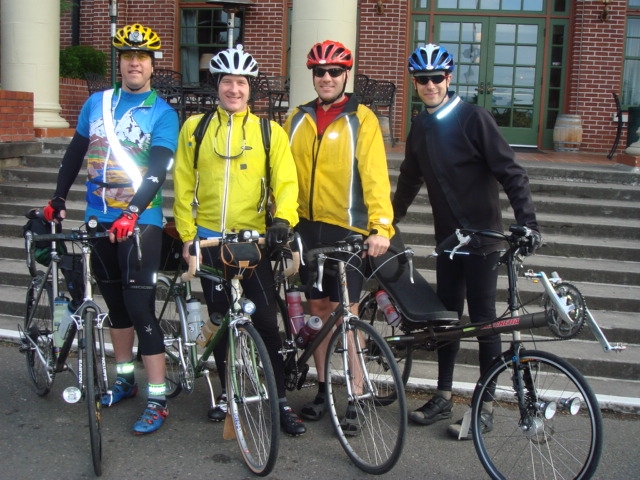
Unfamiliar territory. Although I live less than 3 hours away, my only experience cycling south of the Columbia in Oregon had been on the tedious stretch of highway from the Longview Bridge to Portland on a few Seattle to Portland rides. I knew nothing of the roads that would be on our route. Michael and Sam were fairly casual about creating a route sheet - more of a list of towns and some description of the roads between. It further appeared that some of the roads would be new to them as well.
Challenging route. The first iteration of the fleche route was over 425km. Although this would be my 12th fleche, I couldn't recall ever attempting more than 400km. With some nudging from the fleche organizers, Michael and Sam trimmed out some scenic miles that we would only reach in the dark. But the ride would still be long. (As it turns out, our team took the "overacheivers" plaque for longest distance covered - not a concept with which I would ever expect to be associated!). The aforementioned Eric took pains to point out that if two towns on our route were connected by a relatively flat road or a hilly one, our course headed over the hilly one. One Eric e-mail included the elevation profile for a section with a 2000' summit (vs. 600' on the alternate route). My good friend Greg Cox took pains to let me on a PBP a while back that I "climb like his grandmother"; I am relatively certain that he was not advertising the cycling skills of his ancestors, but rather commenting on mine. I do enjoy climbing, but it doesn't exactly play to my strengths (whatever those might be).
Fussy ankle/aggressive schedule. This year finds me thoroughly infected by the randonneuring bug and I have been doing a lot of riding this spring. Since the last week in January, I think I've put in at least a 200km randonneur ride every weekend. For May, my plans had 4 400km+ weekends - the Oregon fleche, the SIR 400km brevet, the DC 400km brevet, and the volunteers pre-ride of the SIR 600km brevet. The joy of riding has banished all reason from my scheduling. My ankle, never previously a troublemaker, started to bother me on our Fleche NW two weeks ago. Unwilling to accept logical explanations about rest and recover, I chose to attribute the issue to a new pair of shoes. Last weekend on the Carbon River Permanent with my old shoes, my ankle didn't get worse. It still felt a little punk, so I had that on my mind as well.
Why worry? I should have known. The fleche was wonderful. I had a great time on a challenging ride filled with the best of randonneuring.
The team? Yes, these guys are strong, but they are also some of the nicest folks with whom I've had the pleasure of riding. Unfailing cheerful and encouraging, they would wait when catching up was needed, ride ahead when incentive was needed, and drop back to accompany when company was needed. Although I was the only team member with prior fleche experience, all quickly adopted the rhythm of a 24-hour, common finish time.
The route? Unfamiliar roads are no match for the "human cue sheet" that Ed and I discovered in Oregon. We would ride along a nice stretch of road and not worry about missing a turn. Why? Because at every intersection, we'd see Michael and Sam talking and smiling and telling us to "turn left", "go straight", or whatever. Somewhere along the next stretch of road, they would head off to assume their duties at the next intersection.
The distance? Not an issue. Our route of 402km was within my comfort zone (and all the more so for my teammates). I looked back at my average finish time for 400km brevets - 20h16m. On a fleche, this permitted great stops - Black Bear coffee in Vernonia (with delicious apple turnover and chocolate chip oatmeal cookies), sit down lunch at Humps Restaurant in Clatskanie, and late night dinner with the cops and sheriff's deputies (and another fleche team) at the Subway in Tillamook. Michael timed the Subway stop perfectly to get us to our 22hour control right on time, with no waiting around and shivering required. In keeping with fleche tradition, however, we took a short rest in the next available warm, unlocked post office lobby.
The hills? No question that the route was challenging. I'm not sure if any of us had an altimeter on it, but it seemed like 10k-12k feet of climbing on the course, with the hills moderated by some relatively flat stretches along rivers or along the Tillamook Bay. But the roads were wonderful - generally scenic and remarkably low in traffic. Although we could not see the Nestucca River Road scenery overnight, the visual deprivation was countered by the constant companionship of rushing water sounds as we climbed. The gravel section was shorter than advertised and in reasonably good condition, although it did account for our only flat tire of the ride, fixed quickly by Michael in the pre-dawn hours.
Many thanks to Sam, Michael, and Ed for the great route and companionship. Also to the organizers and volunteers who put on the event - Susan France, the local RBA, Michael Rasmussen, Eric Vigoren, and I'm sure many others.

"The Spirit is Willing" team photo courtesy of Ed Felker. (From left: me, Ed, Sam, Michael). More of Ed's fleche pictures are available here.


Sunday, April 29, 2007
A beautiful day
No epic randonneur adventures to report, but I did have another weekend with at least 200 randonneur kilometers. Peter McKay, Mike Richeson, Rick Haight, and I rode the Carbon River permanent on Saturday. We had great weather, with forecast morning showers a DNS for the day. Nice terrain for the single speed. Enjoyable company and good coffee and food stops. "A beautiful day . . . and we were on our bicycles."
Next weekend the Oregon flèche.
Next weekend the Oregon flèche.
Tuesday, April 24, 2007
In praise of "stupid"
My friend Kent Peterson says the flèche is a "stupid ride" and he may have a point. The flèche has all sorts of oddball rules and (at least in the Northwest) is always cold or wet or both.
But last weekend, I participated in my 11th flèche, so the format must appeal to me. (The alternate explanation, that I'm simply not too bright, does nothing for me, thank you). So what's the attraction? In my case, more than one:
The team.
The flèche is a team event in a profoundly individual sport. Over the years, I’ve cycled many a solo brevet kilometer – whether because I was on a solo organizer’s pre-ride of a 1000km brevet or because I was dropped like a hot potato at the beginning of a 300km this spring (on single speed when the others weren’t – at least that’s my excuse and I’m sticking with it). I love those kms – just me and my bike out on the roads. Of course, I’ve cycled many more kms in the company of good friends and enjoyed them too. On a brevet, however, this companionship is optional – If I’m dragging, I can always tell the other riders to go on ahead for the betterment of their ride experience and of mine.
It helps to have a great team. On this ride, Wayne Methner, Peter McKay, Rick Haight, and Robin Pieper were mine.
 Wayne and I met on brevets in 1998, the first year for both of us in randonneuring.
  likely to be much better as it is to be worse.
I’ve shared more randonneur experiences with Peter McKay than with any other rider. Paris-Brest-Paris twice, Boston-Montreal-Boston twice, and thousands of kilometers of Seattle brevets in between. Regardless of the conditions, Peter reminds me (and I remind him) on every ride that “It's a beautiful day . . . and we're on our bicycles.” Like an old married couple, we’ve been together for better and for worse over a lot of rides. We’ve also shared enough motel rooms that our “other” spouses must just wonder.
 Peter, Wayne, and I rode a flèche together in 1999 and have been on many together since. I was on a team with Robin a couple years ago. I’m sure we only invited him as
  part of a package deal with his lovely wife Amy, but discovered that he’s a great riding companion in his own right. Amy and Robin have become mainstays of the SIR scene – strong cyclists, dedicated volunteers, and genuinely wonderful people. This year we let Robin ride with us even without Amy. This was my first flèche with Rick, but not my first time riding with him. Rick is a charter member of the “tow-a-suffering-Mark-to-the-finish-of-a-long-brevet” club, waiting for me in Marblemount on the first Cascade 1200 in 2005 and keeping me company to the finish.
The time management challenge.
The rules of the flèche add an odd challenge. Because you have to go for 24 hours with no more than two hours rest at any point and because you can't get closer that 25km to the end at the 22 hour point, it is the only randonneuring event where I have to worry about going too quickly as well as too slowly. Waiting around in a cold rain (as is often present) at the 22 hour point for the 22nd hour to come can really be unpleasant.
Over the first hundred miles, we were averaging about 20kph including our stops. At that rate, we would cover our 370km course in 18 hours or so. That meant that we would need to burn off almost six hours along the way.
On flèche rides a few years ago, this was no challenge – the team would check into a motel along the way, sleep an almost civilized 5 hours and ride to the finish. A few years back, however, the ACP added a rule that no stop could be more than two hours. We considered stopping at a motel for a 2 hour break, but somehow no one wanted to be the one to say “it’s just the five of us and we only need the room for an hour or so.”
Time burn tactic #1: Stop at the Beehive Restaurant (with next-door Honeycomb Lounge) in Montesano for dinner. Meet Amy Pieper and two locals for good conversation and lots of food in a classic setting. The Beehive has been there for decades, probably with the same charming waitresses the whole time. We stretched the limits of their patience as various sweaty randonneurs followed dinner by sprawling every which way for a nap. The closest to a complaint was a warning from the older waitress that “those boys better not sleep too long; we’re closing at quarter to ten.”
Time burn tactic #2: Get lost in
Time burn tactic #3: Kill a lot of time at the 24-hour Denny’s Restaurant in
Time burn tactic #4: In an effort to burn time and to warm up (temperatures had dipped into the 30s), we stop at the post office in
Time burn tactic #5: A long breakfast. In addition to managing our pace to avoid reaching the 22 hour point too soon, we also hoped not to be too early for breakfast at the Loggers Landing restaurant in Quilcene – open at 7AM daily. The sun was coming up as we crested Walker Pass northbound but the north side of the hill was 5 degrees colder than the south side (back in the mid-30s again). With time spent regrouping at the top, we were extremely cold coming down. We were also too early with a 6:40 arrival likely, but we hoped that we might prevail upon the proprietors to let us in early while they set up. Debating which of us would make the most pathetic case, we concluded that all were equally qualified. Cruising into the Loggers Landing, we saw a half-dozen pickups parked outside. Maybe we had the opening time wrong? No, the sign still said 7AM. Tentatively pushing on the door, we were warmly greeted: “They aren’t opening for a while yet, but the owner gives us a key to come in for our early morning coffee. Help yourselves to some.” Now, that’s my kind of place. Coffee and warmth until the cook arrives to make a terrific breakfast.
Success: We arrive at our predetermined 22hour point, 18 miles from the finish, with a minute to spare.
The party.
My particular flèche prejudice: the essence of the event is that multiple teams follow different routes to converge on a celebration. I’ve heard of flèche events where teams of riders go out and ride 360km or more and then go home, never seeing the other teams. Makes no sense at all to me.
The French converge on
Trinkets.
Last, but not least, I’m attracted to the trinkets. Yes, I ride for the feeling of accomplishment, but mostly I ride for shiny pieces of metal. The lovely Flèche Northwest pin. The possibility of another Randonneur 5000 medal.
Maybe it’s a stupid event, but I love it. Did someone say that the Oregon Randonneurs are holding a flèche in two weeks?
Subscribe to:
Posts (Atom)